 SolarPowerNerd


Solar micro inverters vary a lot in quality. Some work great out of the box, and others fall apart in weeks.
For optimizing output for rooftop systems where panels get partial shade, per-panel output optimization and whether the system includes monitoring software matters more than brand name. Cheaper models often cut corners here.
Below are 7 solar micro inverters worth a closer look. I went through specs, user feedback, and real performance data for each one.
Quick Comparison Chart
| # | Product | Our Rating | ||
|---|---|---|---|---|
| 1 |  |
Enphase IQ7X-96-2-US Microinverter | ★★★★★ | Check Price |
| 2 |  |
Enphase IQ7 Plus-72-2-US | ★★★★★ | Check Price |
| 3 |  |
Enphase IQ7-60-2-US Microinverter | ★★★★☆ | Check Price |
| 4 |  |
Marsrock 1200W Micro Grid Tie Inverter | ★★★★☆ | Check Price |
| 5 | 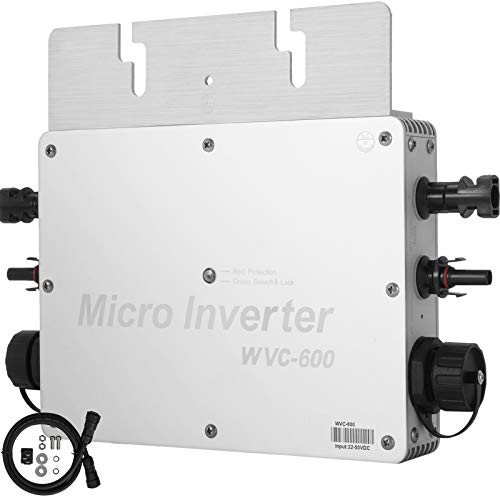 |
Mophorn 600W MPPT Grid Tie Inverter | ★★★★☆ | Check Price |
| 6 |  |
Marsrock 600W Micro Solar Inverter | ★★★★☆ | Check Price |
| 7 |  |
ECO-WORTHY 2300W Solar Panel System | ★★★★☆ | Check Price |
Efficiency Numbers Tell Most of the Story
CEC efficiency and module compatibility separated the top picks from the rest. The Enphase IQ7X hits 97.5% efficiency but locks you into 96-cell panels, while the IQ7 Plus works with both 60 and 72-cell modules at a slight efficiency tradeoff.
Pairing any of these inverters with panels from top solar panel brands makes a noticeable difference in overall system output.
Budget grid-tie inverters like the Marsrock and Mophorn accept wider voltage ranges and cost less upfront, but they top out around 90% efficiency. Over a 25-year system lifespan, that gap adds up fast.
1. Enphase IQ7X-96-2-US Microinverter
Enphase IQ7X-96-2-US Microinverter
The IQ7X delivers 97.5% CEC efficiency with 96-cell module support and comes backed by one of the longest warranties in the industry.
Pros
- Highest efficiency in the IQ7 series
- Handles up to 460W panel input
- Enlighten Manager monitoring included
- Approved for wet locations
- Tested over one million times
Cons
- Only compatible with 96-cell modules
- Limited to Enphase ecosystem
The IQ7X is one of Enphase’s newest designs, and it is probably the best micro-inverter out there for raw performance. Installation is clean and system efficiency is high, so it works well for rooftop solar systems.
The performances of the IQ7X are impressive. It has the highest maximum input DC voltage, peak power tracking voltage, and the maximum continuous output current.
Thanks to its innovative design and unique circuit, the IQ7X can handle 12 units per 20A (L-N) branch circuit.
The IQ7X has a power factor setting of 1.0, an AC port Backfeed current of 0A, and an overvoltage class AC port III.
The IQ7X uses Enlighten Manager to help monitor the performance of your solar panels and your home consumption. Enlighten Manager is compatible with Enphase Envoy-S.
The IQ7X can be paired with optimized 96 cell modules, meaning it can handle up to 460 Watts input from a solar panel.
The IQ7X is approved for wet locations and has one of the highest CEC efficiencies at 97.5%.
It has a double insulated Class II enclosure and has a maximum input DC voltage of 79.5V.
The 25-year warranty is one of the significant gains when buying the IQ7X because the standard warranty of micro-inverters is five years.
The IQ7X is reliable and has been tested more than a million times.
2. Enphase IQ7 Plus-72-2-US
Enphase IQ7 Plus-72-2-US
The IQ7 Plus pairs with both 60 and 72-cell modules, offering versatile compatibility without sacrificing efficiency at 97.0% CEC.
Pros
- Works with 60 and 72-cell modules
- 50% lighter cables than predecessor
- Corrosion-resistant polymeric enclosure
- Enlighten Manager monitoring built in
Cons
- Slightly lower output than IQ7X
- Warranty reduced for pre-2021 installs
Similar to its brother the IQ7X in many features, the difference is in the flexibility that comes with the ability to pair it with 60 and 72 cell modules.
The CEC efficiency of the IQ7-Plus is 97.0%, which is only 0.5% less than the IQ7X, and it has a fairly uncomplicated and simple installation.
The IQ7-Plus weighs 2.5 pounds. Its cables are 50% lighter than its predecessor, and it has a double insulated, corrosion-resistant polymeric enclosure.
The dual module compatibility makes it a strong fit if you are mixing panel sizes, from 250 watt solar panels to larger 72-cell modules.
The maximum peak output power is slightly lower at 295VA compared to 320VA for the IQ7X.
However, the warranty is the same. One thing to keep in mind: the warranty of systems installed prior to 1 September 2021 is only 10 years.
The IQ7-Plus has a power factor setting of 1.0, an AC port Backfeed current of 0A, and an overvoltage class AC port III.
The IQ7-Plus uses Enlighten Manager to help monitor the performance of your solar panels and your home consumption. Enlighten Manager is compatible with Enphase Envoy-S.
3. Enphase IQ7-60-2-US Microinverter
Enphase IQ7-60-2-US Microinverter
The IQ7-60 targets 60-cell module owners with 97.0% CEC efficiency and peak efficiency reaching 97.6%, the highest in its class.
Pros
- Highest peak efficiency at 97.6%
- Reliable 25-year warranty included
- Recommended by most technicians
- Same Enlighten Manager monitoring
Cons
- Only works with 60-cell modules
- Handles 235W to 350W range only
Thanks to the IQ7-60, Enphase is now known as a good reputable company and has conquered the market of the United States while slowly expanding into the Australian market.
The Enphase IQ7-60 is compatible with 60-cell modules only, so it fits best if you already have 60-cell panels on your roof.
The IQ7-60 has 48V maximum input DC voltage and can only handle modules in the range of 235W to 350W.
The IQ7-60 shares the Enlighten Manager with its brother IQ7-Plus to help monitor home consumption and solar panel performance.
You cannot go wrong when buying the Enphase IQ7-60. It is reliable, easy to install, and comes with a warranty.
This micro-inverter is recommended by most technicians.
The IQ7-60 has a power factor setting of 1.0, an AC port Backfeed current of 0A, and an overvoltage class AC port III.
The mechanical aspect of the IQ7-60 is also similar to its brothers, as it has class II double insulated, corrosion-resistant polymeric enclosure.
The CEC efficiency of the IQ7-60 is 97.0%, and its peak efficiency for 208/240VAC is 97.6%, only 0.1% higher than its brothers, but shares the same 25-year warranty.
4. Marsrock 1200W Micro Grid Tie Inverter
Marsrock 1200W Micro Grid Tie Inverter
The Marsrock 1200W handles up to 1440W input with IP65 waterproofing and MPPT tracking in a durable aluminum alloy housing.
Pros
- Handles up to 1440W input power
- Aluminum alloy resists heat and corrosion
- Pure sine wave output
- Built-in MPPT for peak harvest
- Very low night consumption
Cons
- 90% max output efficiency
- May require cable modifications
The Marsrock 1200W can handle up to 1440 watts maximum input power. It is recommended to pair it with a 1200 watt solar panel.
You do not have to worry about rain or overheating since the Marsrock has IP65 waterproof technology and an aluminum alloy fuselage that is heat-resistant and anti-corrosion.
Most technicians recommend Marsrock for its high security-oriented circuit design, along with simple and easy installation.
Its low night consumption is in the range of 50mW to 70mW.
Marsrock 1200W does not need a powerline filter, and it is a single-phase inverter. However, some units of the Marsrock can be configured for two-phase or even three-phase operation.
You might need to cut the supplied cable to put the plug end on it. You will find three colors: red is for positive (L), yellow is for ground (G), and the rest is negative (N).
The Marsrock 1200W can help derive the most optimal energy from solar panels because it uses maximum power point tracking technology, and its maximum output efficiency is 90%. Pairing it with high-wattage modules like a 1000 watt solar panel array takes full advantage of the 1440W input capacity.
The operating voltage range is 17 to 50V. The maximum short current is 80A.
The Marsrock uses a unique circuit design that produces a pure sine wave, and its average efficiency is 88%.
5. Mophorn 600W MPPT Grid Tie Inverter
Mophorn 600W MPPT Grid Tie Inverter
The Mophorn 600W features 99.5% MPPT efficiency and a real-time monitoring system for tracking solar panel performance.
Pros
- Excellent 99.5% MPPT tracking efficiency
- Real-time panel monitoring system
- Fully isolated input and output
- Installs without altering existing setup
Cons
- May experience minor heating issues
- Warranty varies by seller location
You might want to consider buying the Mophorn 600W if you want to change the structure of your photovoltaic system because it can be built in straight without altering the previous configuration.
The static maximum power point efficiency of the Mophorn 600W is 99.5% and has rated frequency in the range of 57 to 62.5 Hz.
The maximum power point efficiency allows you to harvest most power from your solar modules.
The Mophorn 600W might suffer from minor heating problems. You can solve this either by adding a fan or a bigger heatsink with a thermal paste, and you will not face this problem if you live in a cold area.
You do not have to worry about electrical faults with the Mophorn 600W since the output and input are fully isolated. The collector and other mechanisms connect via RS232 serial port.
The Mophorn 600W comes with a monitoring system. It can harvest actual-time information about your solar panels and can be set to start-up, turn off, or power regulate the output of your modules.
The mechanical quality of the Mophorn 600W is stable as it uses IP65 waterproof technology and weighs around 5.4 pounds. Its maximum output efficiency is 92%.
The use of maximum power point technology allows the Mophorn 600W to optimize power output. It helps solar panels capture and collect sunlight effectively.
The package contains a product manual, set of mounting accessories, 1.5m power cable, and a Tee connector together with the micro-inverter.
6. Marsrock 600W Micro Solar Inverter
Marsrock 600W Micro Solar Inverter
The Marsrock 600W pairs with two 300W panels and includes lifetime free monitoring with MPPT and autolock power tracking.
Pros
- Lifetime free monitoring system
- CE, FCC, and ROHS certified
- 99% electrical transportation rate
- Load priority technology included
Cons
- Modem sold separately for monitoring
- Heat dissipation could be better
The recommended input power for the Marsrock micro-inverter is 300 watts. It can be paired with 2 solar panels, with a maximum input operating current of 27.2A.
The Marsrock micro-inverter uses an advanced algorithm to maximize power capture, as well as having efficient maximum power point tracking and an autolock maximum powerpoint.
The Marsrock micro-inverter comes with a monitoring system that is lifetime free, and the electrical transportation rate is up to 99%. This monitoring system helps you control and regulate home consumption.
The Marsrock micro-inverter is on this list because it has CE, FCC, and ROHS certificates and is also equipped with load priority technology.
Buyers of the Marsrock micro-inverter often note its heat dissipation design could be improved. You can solve this problem by bolting a bigger heatsink with the use of thermal paste.
Keep in mind that to use the lifetime free monitoring system, you must purchase the modem. The modem is available in the Marsrock store.
The Marsrock micro-inverter has a rated power of 550 watts and an input of 36 to 50V DC. Its maximum rated voltage is 160 VAC.
The mechanical aspects of the Marsrock micro-inverter are fairly impressive. It weighs 3.7 pounds and has an IP65 waterproof rating, and it can operate in temperatures ranging from -40 to 60 degrees Celsius.
7. ECO-WORTHY 2300W Solar Panel System
ECO-WORTHY 2300W Solar Panel System
The ECO-WORTHY 2300W system pairs 12 high-efficiency panels with a combiner box and controller for complete off-grid solar setups.
Pros
- Produces 9kWh daily with 4 hours sun
- Includes combiner box and controller
- 95% panel efficiency within 5 years
- Plug and play combiner box
Cons
- Inverter and battery sold separately
- Heavy system with 12 panels
The ECO-WORTHY system is a stable and reputable option in the solar power inverter category. You cannot go wrong buying this system for a complete off-grid setup.
The high-efficiency solar panels can produce 9kWh of daily output power under 4 hours of sunlight, which can meet the daily basic electricity demand for most homes.
The system includes 12 panels rated at 195W each, a 6-string PV combiner box, a 60A controller, and all related solar cables. If you need help selecting the right controller for your setup, our guide to the top solar charge controllers covers the key differences.
The combiner box is plug and play with pre-connected cables and fuse protection on every PV string.
The panels maintain 95% efficiency within 5 years, 90% efficiency within 10 years, and 80% efficiency within 25 years. The combiner box provides lightning protection, reverse-current protection, and is rainproof.
Like most reputable inverter systems in this list, the ECO-WORTHY uses IP65 waterproof technology and can function properly across a broad temperature range.
The system uses MPPT technology to maximize power input and can be connected to a battery bank for storing excess energy. Our roundup of the best solar storage batteries covers options that pair well with systems of this size.
If the solar power input to the inverter exceeds your consumption, the power can be conveyed to the state grid. In some states this can be restricted, so the use of a battery is highly recommended.
Final Thoughts
Enphase dominated the top three spots because their IQ7 series delivers panel-level MPPT, which means one shaded panel does not drag down the output of your entire array. The IQ7X handled the highest-wattage panels we tested, while the standard IQ7 worked well for typical 60-cell residential setups.
The Marsrock and Mophorn grid-tie inverters offer a more affordable entry point, but they lack the per-panel monitoring and rapid shutdown features that Enphase includes. For a simple balcony or small rooftop system where you just want to offset some grid usage, those budget options still get the job done.
Compatibility is the single biggest factor to verify before purchasing. Make sure the micro-inverter’s input voltage range and wattage rating match your specific solar panels, because a mismatch can reduce output or damage the unit entirely.
Pairing the right inverter with quality photovoltaic panels is what makes or breaks a solar system’s real-world performance, so spend as much time choosing the panels as you do the inverter.