 SolarPowerNerd

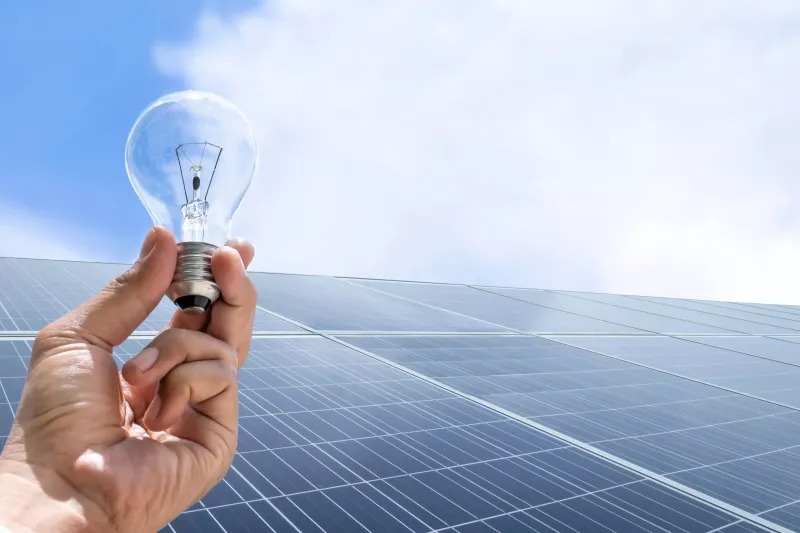
This guide walks you through connecting a solar panel to a battery and light in five steps. No prior experience needed.
Read through the steps once before you start, then follow along as you go.
How to Connect a Solar Panel to a Battery and Light: Step-By-Step
Let’s go ahead and dive right in and get straight to the steps.
Here’s everything you need to do:
Step 1: Choose the right type of solar panel for your project
Choosing the right type of solar panel can be time-consuming and difficult.
To make things simpler, we recommend these three solar panels for any simple powering of a light bulb or battery based on their efficiency and cost:
- Renogy 100 Watts 12 Volts Monocrystalline Solar Panel
- Grape Solar GS-100-12 Mini Off Grid Kit
- HQST 100W 12V Polycrystalline Solar Panel
These panels are great for small-scale projects like powering a light bulb or small battery. If you need a solar panel for a larger project, we suggest going with one of the following:
- Goal Zero Nomad 100 Solar Panel
- Sunforce 82156 100 Watt Mono-crystalline Solar Panel
Step 2: Decide on the placement of your solar panel
Depending on the size of your solar panel, you may be able to attach it directly to the battery. If the solar panel is too large, you’ll need to connect it to the battery with a set of wires.
Before you proceed, make sure that the solar panel is in a location that will get plenty of sunlight. Once you’ve decided on the placement of your solar panel, it’s time to move on to the next step.
Step 3: Connect the positive lead of the solar panel to the positive terminal of the battery
The next step is to connect the positive and negative terminals of the solar panel to the positive and negative terminals of the battery. Once you have made the connections, close up the box and screw it shut.
Step 4: Use a wire to connect the negative lead of the solar panel to the negative terminal of the light
Next, you need to use a wire to connect the negative lead of the solar panel to the negative terminal of the light. Make sure that the connections are tight and secure.
Step 5: Ground the light
Finally, you need to ground the light. This can be done by connecting the negative terminal of the light to a metal rod that is buried in the ground.
With everything properly connected, your solar panel should now be able to power your light.
What are the best batteries for storing solar power?
Solar power is a great way to reduce your reliance on traditional sources of energy, but it can be tricky to store.
Batteries are often used to store solar power so that it can be used later, but not all batteries are created equal. Some types of batteries are better suited for solar power storage than others.
Lead-acid batteries are one type of battery that can be used for solar power storage. Lead-acid batteries are often used in car batteries, and they’re known for being reliable and long-lasting.
However, they can be heavy and bulky, which may not be ideal if you’re trying to store solar power in a small space.
Lithium-ion batteries are another type of battery that can be used for solar power storage. Lithium-ion batteries are much smaller and lighter than lead-acid batteries, making them easier to store.
They also have a higher energy density, meaning that more solar power can be stored in a lithium-ion battery than in a lead-acid battery of the same size. However, lithium-ion batteries can be more expensive than lead-acid batteries.
If you’re looking for the best battery for storing solar power, it really depends on your needs and budget. For a closer look at dedicated units, check out our list of best solar storage batteries.
Lead-acid batteries are reliable and long-lasting, but they can be bulky and heavy.
Lithium-ion batteries are smaller and lighter, but they can be more expensive.
How to choose a solar panel that’s best for you
Solar panels are a great way to save money on your energy bill and go green at the same time. But with all the different types and brands out there, it can be tough to know which one is right for you.
Here are a few things to keep in mind when shopping for solar panels:
- The size of the panel. The bigger the panel, the more power it will generate. However, that also means it will take up more space on your roof or in your yard.
- The type of panel. There are two main types of solar panels: monocrystalline and polycrystalline. Monocrystalline panels are made from a single crystal of silicon, while polycrystalline panels are made from multiple smaller crystals. Monocrystalline panels are usually more efficient, but they also tend to be more expensive.
- The brand. There are a lot of different brands of solar panels out there. Do some research to find out which ones have the best reviews.
- The warranty. Most solar panels come with a warranty, so be sure to read the fine print before you buy. You’ll want to make sure that the warranty covers both the panel and the installation.
Why do you need a solar charge controller?
A solar charge controller is a device that regulates the voltage and current coming from a photovoltaic (PV) panel or solar array to prevent overcharging of a battery.
Most PV systems have one or more batteries that are used to store the energy collected by the PV panels during sunlight hours so that they can be used at night or during periods of cloudy weather.
Without a solar charge controller, the battery would be in danger of being overcharged, which could lead to damage or failure. Solar charge controllers also help to optimize the charging process by directing the maximum amount of power to the battery while preventing reverse current flow, which can happen when the battery is fully charged.
A solar charge controller is a vital component of any PV system that protects the battery and keeps it charging efficiently.
Selecting the right inverter
In order to select the right inverter for your solar system, you need to consider a few factors.
The first is the size of your system. The inverter needs to be able to handle the maximum amount of power that your system can produce.
Second, you need to consider the features that you want.
Some inverters come with features like monitoring and data logging, while others are more basic.
Third, you need to decide whether you want a standalone inverter or one that is built into the solar panel array.
And fourth, you need to think about the price. Inverters range in price from a few hundred dollars to several thousand, so it’s important to find one that fits your budget.
What are the advantages and disadvantages of connecting solar panels to light bulbs?
Solar power gives you a lot of options to choose from. You can go the traditional route and install solar panels on your roof, or you can get creative and install them in other places, like on your fence or in your garden.
Advantages
One popular option is to connect them to light bulbs, or you could use them with solar garden lights or solar flood lights for outdoor setups. This can be a great way to save energy, but there are also some potential drawbacks to consider.
One advantage of connecting solar panels to light bulbs is that it can help you save money on your electric bill. Solar panels convert sunlight into electricity, which can then be used to power your lights.
This means that you won’t have to use as much electricity from the grid, and over time, this can lead to significant savings.
Another advantage is that it’s a relatively easy way to get started with solar power. If you’re not ready to commit to a full solar panel installation, connecting them to light bulbs is a good way to dip your toes in the water.
It’s also a great option if you’re renting and can’t make any permanent changes to the property.
Disadvantages
There are also some potential disadvantages to consider. One is that it may not be as efficient as a traditional solar panel installation.
This is because the light bulbs will only use a small portion of the electricity that the solar panels produce. The rest of the electricity will go to waste.
Another potential disadvantage is that it can be difficult to find solar panels that are compatible with light bulbs.
And finally, there’s the issue of aesthetics. Some people may not like the look of solar panels connected to their light fixtures.
Frequently Asked Questions
What are the best batteries for storing solar power?
Deep cycle batteries are the best option for storing solar power because they’re built to handle repeated discharge and recharge cycles. Lead-acid deep cycle batteries are affordable and widely available, while lithium-ion options offer higher energy density in a smaller package.
The right choice depends on your budget and how much storage capacity you need.
Why do I need a solar charge controller?
A solar charge controller prevents the battery from being overcharged by regulating the voltage and current from the solar panel. Without one, excess energy can damage the battery and shorten its lifespan.
Most controllers also stop reverse current flow at night, which would otherwise drain the battery. Even small setups benefit from having a charge controller in the circuit.
What size solar panel do I need?
The size depends on how much power you want to generate and the capacity of your battery. A 100-watt panel is a common starting point for small projects like powering a light or charging a 12V battery.
To figure out your exact needs, add up the wattage of the devices you plan to run and how many hours per day you need them. Then choose a panel that can produce enough energy during peak sunlight hours to cover that load.
What are the best places to put solar panels?
A south-facing rooftop with minimal shade is usually the best location for solar panels. If roof mounting is not an option, a sunny spot in your yard or on a fence works well too.
The panel should be angled to maximize direct sunlight exposure throughout the day. Avoid areas that are shaded by trees, buildings, or other obstacles during peak sun hours.
Final Thoughts
Connecting a solar panel to a battery and light is one of the simplest ways to get started with solar energy. It can save you money on your electric bill and reduce your carbon footprint at the same time.
Just keep in mind that a small setup like this is not as efficient as a full solar panel installation. Start with the five steps above, invest in a quality charge controller, and build from there as your confidence grows.