 SolarPowerNerd

Solar energy keeps getting cheaper, and the reasons to invest go well beyond your electricity bill. These 10 points cover the financial, environmental, and practical benefits that matter most right now.
What Are The Benefits of Solar Energy?
Solar systems are more affordable than ever, and they produce free energy without the waste materials that pollute our planet. Global warming and excessive carbon dioxide emissions are damaging the environment, and solar is one of the most direct ways to fight back.
By installing collectors, we get renewable energy and reduce our dependence on fossil fuels. You can collect and use solar energy that is free of charge.
Studies around the world consistently show that solar power delivers more benefits than drawbacks.
If you’re wondering whether solar panels are worth it for your home, the short answer is yes for most homeowners. There is a growing focus on the ecological production of energy from renewable sources, and solar leads the way.
Why Are Renewable Energy Sources Important?
People are looking for ways to make greater savings while protecting the planet, and the sun has enough energy to meet the needs of all of us. With so many sunny days throughout the year, it’s hard to justify paying more for conventional electricity when a more effective alternative costs almost nothing.
Solar energy can be used indirectly as heat or directly to generate electricity using photovoltaic panels. Heat energy can be used for hot water supply, space cooling and heating, or indirect electricity production.
For backup during cloudy stretches, solar storage batteries keep your system running around the clock.
With that said, let’s get started with our list of the 10 greatest reasons for investing in solar energy.
What Are the Benefits of Investing in Solar Panels?
1. Solar Power Saves Money
Reduce energy costs by using renewable energy from the sun. Whenever we talk about solar energy, we first think about an expensive electricity generating system (photovoltaics).
This can cost tens of thousands of euros.
Solar panels for hot water production can range from several hundred to several thousand euros. One household that pays 600 euros a year for consumed electricity consumes 7,000 kWh.
This amount of energy can be produced with a 5 kW photovoltaic system, which costs around 6,000 euros.
After the installation, the energy you receive is essentially free. The higher the price of oil and gas, the more you save.
When we use solar power, we save money because we do not rely on electric energy in our everyday life.
Watch: Why Solar Energy Is Worth the Investment
Solar energy is unlimited renewable energy, and it’s certainly more cost-effective than conventional electricity. Many countries now provide subsidies to those who want to adopt solar energy.
The state returns part of the cost to those who use solar power in their homes.
2. Solar Energy is Infinite
When we say that solar power is infinite, we think of how long we can use it. Actually, solar power is not truly infinite, but it will last at least 100 billion years.
It’s renewable, and you can use it whenever you like and as much as you need.
The sun will always be there. It’s not going anywhere.
As long as the sun exists, sunlight will be there for our energy needs.
3. Opportunity For More Jobs
Thanks to solar power investment, many jobs have been created. This industry now needs installers, mechanics, construction workers, and electricians.
Many devices now run using solar power, including solar street lights, solar battery chargers, and solar mobile chargers.
The EY report also shows that the European Union is pushing for renewable energy sources from 27% to 35% by 2030. This could bring 120,000 additional solar energy jobs, for a total of 328,000 employees in the sector.
Projections in the EY report show that Spain will have the highest number of new jobs. There was a growth of 471% from 2016 to 2021.
Greece’s growth was +403% and Poland at +381%.
4. Solar Power Is Clean and Safe
Solar energy avoids the exploitation of nature and helps protect our planet. The cleanliness of solar power means that it does not produce byproducts that are toxic or harmful.
There are no waste products that can poison the environment or endanger human beings.
As far as safety is concerned, solar power is not as dangerous as electricity. Solar power does not need transformers, unlike electric power.
Transformers are risky because they are almost always installed very close to houses.
In many regions, people worry whenever the weather is bad and thunderstorms arrive. With solar, there is a reduced risk of electrocution compared to conventional grid systems.
5. Solar Power is Renewable
Renewable energy is an energy source that can be gained back from nature with ease. Potentially the largest source of renewable energy is the sun.
It’s a radiant gas ball whose radiation is powerful and a source of power when its light reaches the earth.
It’s quite impossible to exhaust solar power. The intensity of solar radiation on the Earth’s surface depends on the exposure time and the angle of the sun’s rays to the horizontal plane.
Solar energy is safe, free, and the least harmful to the environment. It’s the basis of life on earth and a constant companion to the development of mankind.
As we said, solar power is there as long as the sun is shining. It could last for 100 billion years.
The sun is a medium-sized star with an estimated age of about 4,600 million years, which is thought to be half its life.
That is more than enough time for people who want to develop more projects with solar power. We can safely say that it’s not used enough.
Thanks to solar panels, we can have power during cloudy days because of batteries where solar energy can be stored.
6. Solar Power as a Business
Just looking around us, we can easily see that solar power is a good investment. Our population grows steadily, and people build new houses every day.
Thanks to that, the demand for solar panels is increasing.
It’s not just houses, either. Buildings are starting to use solar power to save on bills and take care of the environment at the same time.
This creates opportunities for entrepreneurs to offer their services and build a positive reputation.
Jobs in the solar power business are also high-paying. Even solar garden lights represent a growing product category for retailers and installers looking to expand into the residential market.
7. More Hot Water During Winter
Hot water requires a lot of energy. More than 40% of the water we use is hot.
If you choose an energy-efficient solution, you will save a lot of money in the long run.
The heating of water done through solar power can cover up to 75% of the total need for fresh, hygienic hot water. Thanks to solar power, we do not have to worry about turning on our water heater and being scared of the monthly bill.
Hot water obtained naturally through a renewable heating system reduces CO2 emissions. The system operates year-round but is dependent on sunny days.
There is a possibility to heat water in a conventional heater during the winter.
For solar water, we can use a solar heater consisting of collectors, a combined boiler with two converters, expansion, automatic solar pan, solar panel, and differential thermostat. It has been statistically proven that a 1m2 solar collector saves 750 kWh of energy per year.
The solar system in summer meets the needs of hot water 90-100%, in the transition period 50-70%, and during winter 10-25%. Solar systems are calculated based on the consumption of sanitary water, so it’s necessary to know how many people are staying in the facility.
The budgets take into account the average consumption of 50 liters per person in the household and smaller tourist facilities. For example, for a facility where 6 people live permanently, 300 liters is required.
The volume of the tank will require 3 collectors of 2m2, as well as other equipment that is an integral part of the solar system.
Related: 10 Best Solar Powered Water Pumps And Their Reviews
8. Ability to Live In Luxury
In the past, people were not so educated about solar energy. They had home appliances but did not use them every day because of exorbitant monthly energy bills.
Nowadays, we don’t have to worry about this.
There are standard home appliances like refrigerators, freezers, cookers, and a lot more equipment that can run through solar power. Solar panels with an area of 7 m2 generate about 1,000 kWh of electricity annually.
Depending on the location of the source of solar radiation, panels ranging from 28 to 40 m2 per year can cover 30 percent of the average household’s electricity demand without storage. For homes that want full rooftop solar systems, larger arrays can offset even more of your electricity usage.
Solar Cars
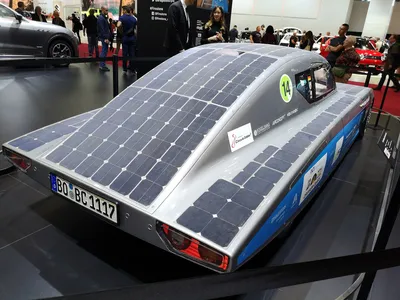
The most exciting development in this area is solar cars. They’re very expensive today, but we expect the price to come down in the near future so everyone can enjoy them.
If countries can finance renewable energy programs, people should be able to use some of the newest and more modern home appliances with the help of the sunlight.
9. Better Quality of Air
Modern society has recognized the many benefits of using solar energy. It’s now possible to reduce dependence on fossil fuels, improve air quality, and reduce greenhouse gas emissions.
Solar energy can be used with renewable energy technology to replace conventional energy systems that consume fossil fuels. This helps reduce the harmful gases in the atmosphere, as well as reduce greenhouse effects and global warming.
There is a need to replace the energy produced from fossil fuels. Mankind is in dire need of energy, and fossil fuels are scarce.
It’s expected that by 2100, the need for energy will be 100 gigawatts, which will mean much higher emissions and greenhouse gases.
Solar energy production creates no noxious environmental emissions. It is silent and odorless.
10. Good For Architecture and Urban Planning
Sunlight has influenced construction from the very beginning of construction history. Fully developed solar architecture is an urban planning method that was first applied by the Greeks, Chinese, and Egyptians.
They oriented their buildings to the south to provide light and heat.
The basic features of passive solar architecture are orientation to the sun, compact proportions (small areas relative to volume), selective shading, and thermal mass. When these characteristics are weighed against the local climate and environment, they can give rise to well-lit spaces that remain at comfortable temperatures.
Socrates’ Megaron House is a classic example of solar design. A recent approach to solar design, using computer modeling, links solar lighting, heating, and ventilation systems to an integrated solar design package.
Active solar equipment like pumps, fans, and switchable windows can also help passive design and improve overall system performance.
Frequently Asked Questions
How much does it cost to install a solar panel system?
The cost of a solar panel system depends on the size of your home, your energy needs, and your location. A typical residential system ranges from 5 kW to 10 kW and can pay for itself within 6 to 10 years through electricity savings.
Many governments offer tax credits, rebates, and subsidies that significantly lower the upfront cost. Once installed, the ongoing maintenance costs are minimal compared to the savings you receive.
Will my solar panels still generate power in cloudy weather?
Yes, solar panels still generate electricity in cloudy weather, though at reduced efficiency. Modern panels can capture diffused sunlight even when the sky is overcast.
Pairing your system with battery storage means you’ll have power around the clock, regardless of weather conditions. Most homeowners find that their annual production still meets or exceeds expectations even in regions with moderate cloud cover.
How many years will a solar panel system last?
Most solar panels come with a manufacturer warranty of 25 to 30 years, and many continue producing electricity well beyond that timeframe. Panel efficiency does decrease slightly over time, typically losing about 0.5% per year.
That means after 25 years, your panels are still operating at roughly 87% of their original capacity. With proper maintenance and occasional inverter replacements, a solar system can serve your home for decades.
Is solar energy worth it if I plan to sell my home?
Solar panels can increase your home’s resale value significantly. Studies have shown that homes with solar installations sell faster and at higher prices than comparable homes without them.
Buyers appreciate the prospect of lower energy bills and a reduced carbon footprint. Even if you plan to move in a few years, the investment in solar often pays off through both energy savings and added property value.
Final Thoughts
At any given time, the solar energy reaching the earth is enough to satisfy global energy needs for a whole year. If technology continues to evolve at its current pace, using renewable energy sources will be more efficient than traditional fuels within the next decade.
Solar collectors are a practical way to capture this energy to save on household costs, achieve energy independence, and reduce general pollution.
The world covers its energy needs with mostly non-renewable sources like fossil fuels, coal, oil, and natural gas. These are limited and will eventually run out.
An efficient solar solution gives you the ability to gain independence from traditional energy suppliers and help keep energy costs low.
From all this, we can conclude that thanks to the sun and human ingenuity, the future holds more money saved and a healthier environment to live in. For a closer look at the specific advantages homeowners gain, our guide on the benefits of solar panels covers the practical upsides in detail.