 SolarPowerNerd


Marine solar setups face problems that rooftop home panels never deal with. Salt spray corrodes exposed connectors in weeks, curved decks and cabin tops need panels that flex without cracking cells, and vibration from engines and wave impact loosens rigid mounting hardware over time.
A kit rated for a house roof will not survive a season on saltwater without upgrades.
The first decision is rigid versus flexible panels. Rigid monocrystalline panels deliver higher efficiency (typically 20 to 22%) and last longer, but they need flat mounting surfaces and add weight.
Flexible panels bend up to 30 degrees to follow hull curves and weigh a fraction as much, though they sacrifice a few efficiency points and have shorter lifespans. The charge controller bundled with the kit matters just as much.
A PWM controller works fine for simple battery maintenance, but an MPPT controller extracts 15 to 30% more power in partial shade and cloudy conditions, which is common on the water.
Most kits in this roundup range from 100W to 200W, enough to keep a trolling motor battery topped off or run cabin lights and a small fridge. If you need to power a full liveaboard setup, you will want to look at expandable systems that support wiring multiple panels in series.
Quick Comparison Chart
| # | Product | Our Rating | ||
|---|---|---|---|---|
| 1 |  |
GioSolar 100W Flexible Solar Panel Charger Kit | ★★★★★ | Check Price |
| 2 |  |
Renogy 100W Solar Power Starter Kit | ★★★★★ | Check Price |
| 3 | 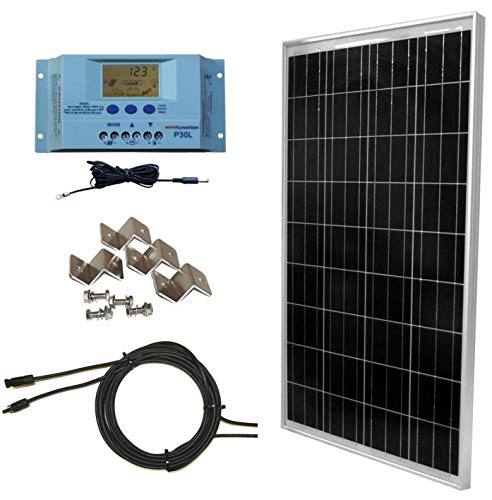 |
WindyNation 100W Solar Panel Kit | ★★★★★ | Check Price |
| 4 |  |
Renogy 100W Monocrystalline Solar Panel | ★★★★☆ | Check Price |
| 5 |  |
200W Flexible Solar Panel Kit | ★★★★☆ | Check Price |
| 6 | 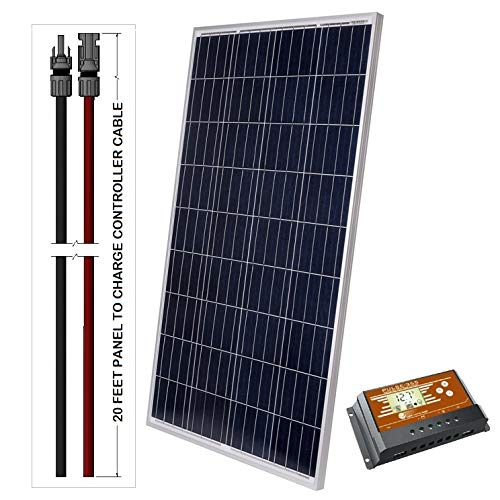 |
LightCatcher Solar 100W Polycrystalline Panel Kit | ★★★★☆ | Check Price |
| 7 |  |
Renogy 200W N-Type Solar Panel Starter Kit | ★★★★☆ | Check Price |
| 8 |  |
HQST 150W Polycrystalline Solar Panel | ★★★★☆ | Check Price |
| 9 |  |
EF ECOFLOW 160W Portable Solar Panel | ★★★★☆ | Check Price |
| 10 | 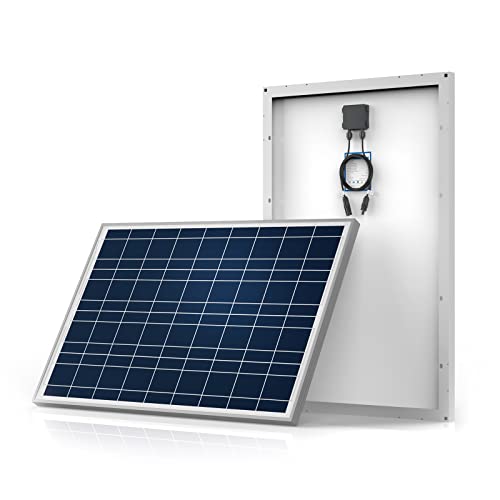 |
ACOPOWER 100W Polycrystalline Solar Panel | ★★★★☆ | Check Price |
Rated for the Water: What Separates a Good Marine Solar Kit
Flexible vs. rigid is the first decision for any boat install. The GioSolar 100W bends to 30 degrees for curved decks, while the Renogy starter kit ships with a rigid panel, Z-brackets, and a 30A controller ready for flat mounting.
Salt air corrodes cheap connectors fast, so every kit here was scored on marine-grade build quality, IP rating, and corrosion resistance. If your connectors are not rated IP67 or higher, plan on replacing them within a season or two.
1. GioSolar 100W Flexible Solar Panel Charger Kit
GioSolar 100W Flexible Solar Panel Charger Kit
A monocrystalline flexible panel that bends up to 30 degrees, bundled with a 20A PWM controller and MC4 connectors for quick marine installs.
Pros
- Flexes to 30 degrees for curved surfaces
- Includes controller, cables, and connectors
- 25-year transferable power output warranty
- Lightweight at under 5 lbs per panel
Cons
- Only 100W total output
- PWM controller less efficient than MPPT
The GioSolar’s flexible monocrystalline panel bends up to 30 degrees, which is enough to conform to most curved cabin tops and deck surfaces without cracking cells. At under five pounds, it adds virtually no weight to your vessel compared to rigid panels in the same wattage range that typically weigh 15 to 18 lbs.
The kit ships complete with a 100W flexible solar panel, a PWM 20A 12V/24V charge controller with LED indicators, 5 meters of solar cable, and MC4 connectors. The 25-year transferable power output warranty is among the longest in this roundup, which speaks to how well the flexible cells hold up over time.
2. Renogy 100W Solar Power Starter Kit
Renogy 100W Solar Power Starter Kit
A complete starter kit with a 100W monocrystalline panel, Wanderer 30A PWM charge controller, Z-brackets, and tray cables for plug-and-play setup.
Pros
- Generates around 500Wh per day
- 22.5% cell efficiency rating
- Expandable up to 400W with added panels
- Bluetooth monitoring with optional BT-1 module
Cons
- Bluetooth module sold separately
- Rigid panel not ideal for curved decks
The Renogy starter kit is the most complete package for someone installing marine solar for the first time. It ships with a 100W rigid monocrystalline panel rated at 22.5% cell efficiency, a Wanderer 30A PWM charge controller, Z-brackets for flat mounting, a 20-foot 10AWG MC4 adapter kit, and 8-foot 10AWG tray cables.
Everything connects with standard MC4 plugs, so there is no cutting or crimping wires.
The system generates roughly 500Wh per day in full sun, which is enough to maintain a trolling battery or run cabin lights overnight. The controller supports expansion up to 400W by adding panels in parallel, so you can start small and scale up.
An optional BT-1 Bluetooth module (sold separately) lets you monitor charging data from your phone.
3. WindyNation 100W Solar Panel Kit
WindyNation 100W Solar Panel Kit
An off-grid kit featuring a 100W panel, LCD-equipped PWM charge controller, 40 feet of solar cable, and full mounting hardware for boats and RVs.
Pros
- LCD screen shows amps, voltage, and load draw
- Provides about 350Wh per day
- Expandable up to four 100W panels
- Adjustable controller settings
Cons
- Mounting brackets need separate purchase
- Heavier than flexible alternatives
The WindyNation kit includes something most competitors skip: an LCD-equipped PWM charge controller that displays real-time system amperage, voltage, amp-hours, and DC load draw. On a boat, that readout lets you see exactly how much power your panel is producing and how fast your battery is charging without any guesswork.
The kit ships with a 100W panel, 40 feet of 12 AWG solar cable (generous enough for larger vessels), all MC4 connectors, and a mounting system. It generates about 350Wh per day and supports expansion up to four 100W panels.
The adjustable controller settings let you fine-tune charging parameters for different battery types, including AGM, gel, and flooded lead-acid.
4. Renogy 100W Monocrystalline Solar Panel
Renogy 100W Monocrystalline Solar Panel
A standalone 100W monocrystalline panel with pre-drilled mounting holes, IP67-rated MC4 connectors, and a corrosion-resistant aluminum frame built for marine use.
Pros
- Handles 2400Pa wind and 5400Pa snow loads
- Pre-drilled holes for fast mounting
- Tempered glass front for added protection
- Positive output tolerance of 0 to 3%
Cons
- Controller and cables sold separately
- Weighs 16.5 lbs
This monocrystalline solar panel is hefty and reliable, making it a solid choice for anyone who needs something stable on the water. It generates strong output even during sunrise and sunset hours, which is why it earned its place on this list.
The panel measures 47 inches long and features tempered glass on the front for added protection against the elements. The corrosion-resistant metal frame provides extra durability in marine environments.
It also pairs well with a 20 AMP solar charging controller and comes with pre-drilled holes and Z-bracket compatibility for quick installation. The 40-foot UL 12AWG 600V cable with MC4 connectors gives plenty of reach for larger boats.
5. 200W Flexible Solar Panel Kit
200W Flexible Solar Panel Kit
A dual 100W flexible monocrystalline panel kit with a 20A charge controller, rated for up to 250-degree arc bending and 1050Wh daily output.
Pros
- Two 100W panels for parallel or series wiring
- Each panel weighs only about 4 lbs
- Up to 1050Wh daily under full sun
- Controller includes overload protection
Cons
- Flexible panels less rigid in high winds
- Thinner construction may need careful handling
This 200W kit is a strong choice for anyone who needs more power and flexibility on the water. It supports both parallel and series connections, giving you options for how you wire your system.
The bundle comes with two identical, lightweight, flexible solar panels that bend to fit curved boat surfaces.
The panels can charge off-grid devices with 12 to 24 volts of electrical power, and the kit is one of the few that handles water pumping and signaling systems. The package includes two 100W flexible solar panels, a 20A LED 12V/24V solar controller, 5M of solar cable with MC4 connectors, and 3M of additional wiring.
6. LightCatcher Solar 100W Polycrystalline Panel Kit
LightCatcher Solar 100W Polycrystalline Panel Kit
A German-engineered polycrystalline kit with a 30A PWM charge controller, grade A solar cells, and 40 feet of MC4 terminated cable.
Pros
- Grade A cells for reliable power output
- 25-year power output warranty
- Expandable up to four panels
- 40 feet of MC4 terminated cable included
Cons
- Polycrystalline slightly less efficient than mono
- Limited PA-API feature data available
This polycrystalline 12V solar panel does more than meets the eye. One of its standout features is the qualified simplicity of its German-engineered design, which makes it a popular choice among beginners who need off-grid energy on the go.
The panel connects to all off-grid appliances and supports expansion up to four panels for those who need more solar capacity in the future. The kit includes a 100W polycrystalline solar panel capable of 105W maximum power output, a 30A PWM charge controller that charges 12V to 24V batteries, and 20 feet of MC4 terminated panel-to-controller wire.
7. Renogy 200W N-Type Solar Panel Starter Kit
Renogy 200W N-Type Solar Panel Starter Kit
A 200W N-type kit with two 100W panels, a 30A PWM charge controller, Z-brackets, and full cabling for 12V off-grid systems on boats and RVs.
Pros
- Produces around 1000Wh per day
- Compatible with sealed, gel, flooded, and lithium
- Built-in reverse polarity protection
- Pre-drilled holes for easy mounting
Cons
- Rigid panels need flat mounting surface
- Two-panel kit takes more deck space
The Renogy 200W N-Type Starter Kit delivers serious output for boat owners who need more than a single panel can provide. Equipped with the most advanced N-type solar cell technology, this kit delivers around 1000Wh per day under direct sunlight.
The high-efficiency solar cells are protected by a durable layer of low-iron tempered glass with patterned coating that helps it endure harsh environmental conditions. The grade A solar cells are long-lasting and protect the waterproof junction box inside each panel.
The kit includes two 100W N-type panels, a 30A PWM charge controller, Z-brackets, and a 15ft MC4 cable.
8. HQST 150W Polycrystalline Solar Panel
HQST 150W Polycrystalline Solar Panel
A heavy-duty 150W polycrystalline panel with a corrosion-resistant aluminum frame, pre-drilled mounting holes, and low-iron tempered glass.
Pros
- Delivers about 500Wh per day
- Compatible with 12V and 24V systems
- Corrosion-resistant aluminum frame
- Anti-reflective tempered glass coating
Cons
- Heavier than 100W alternatives
- Polycrystalline cell efficiency lower than mono
The HQST 150W 12V Polycrystalline Solar Panel is durable, effective, and well-suited for boat owners who need a serious energy source. This kit has been designed for beginners and experienced users alike, with pre-drilled holes on the panel for quick installation.
Capable of charging 12 to 24-volt batteries, this heavy-duty panel delivers about 500 watt-hours per day depending on sunlight availability. The kit comes with an HQST 12V Polycrystalline Solar Panel, HQST 30 AMP PWM Smart Solar Charge Controller, HQST Solar Adapter Cable, and solar panel mounting Z brackets.
9. EF ECOFLOW 160W Portable Solar Panel
EF ECOFLOW 160W Portable Solar Panel
A foldable, IP68 waterproof 160W solar panel with an integrated kickstand case, weighing 15.4 lbs for easy transport to the dock or deck.
Pros
- Folds flat for compact storage
- IP68 waterproof with seamless construction
- Kickstand case doubles as a stand
- Works right out of the box
Cons
- Weighs 15.4 lbs when folded
- Optimized for EcoFlow power stations
The EF ECOFLOW 160W Portable Solar Panel is compact, quick to set up, and ideal for boaters who are always on the go. This waterproof, foldable solar panel works right out of the box with no assembly needed.
The integrated kickstand case provides protection during transport and doubles as a positioning stand for optimal sun exposure. When a battery is fully charged, the smart charging system disconnects automatically.
Although the unit weighs 15.4 lbs, the foldable design makes storage and transport easy for any boat or dock setup.
10. ACOPOWER 100W Polycrystalline Solar Panel
ACOPOWER 100W Polycrystalline Solar Panel
A rugged 100W polycrystalline panel with 3.2mm tempered glass, a waterproof junction box, and an aluminum frame built for marine and off-grid use.
Pros
- Withstands high winds and snow loads
- 3.2mm tempered glass for impact resistance
- Waterproof junction box for marine use
- Pre-drilled for fast installation
Cons
- Panel only, no controller included
- Polycrystalline efficiency trails monocrystalline
The ACOPOWER 100W Polycrystalline Solar Panel is sturdy and includes a 12AWG cable with male and female connectors. This panel fits on boats, cabins, RVs, and more while withstanding high winds and heavy snow loads.
The 3.2mm thick tempered glass coating makes it tougher than many competitors, and the aluminum frame covers the surrounding edges for added safety and durability. The waterproof junction box allows it to work at full capacity in marine environments, making it a solid pick for boat owners who need a reliable standalone panel.
Final Thoughts
Flexible panels like the GioSolar 100W earned their spot at the top because they conform to curved boat surfaces that rigid panels simply cannot mount to. On a sailboat or smaller vessel with limited flat deck space, that flexibility is not a luxury but a necessity.
The Renogy kits showed up multiple times on this list for good reason. Their charge controllers, wiring, and connectors are consistent across products, which makes expanding your system later straightforward without hunting for compatible parts from different brands.
Saltwater corrosion is the hidden challenge that separates marine solar from land-based setups. Panels with sealed junction boxes and corrosion-resistant frames held up dramatically better over time, so paying a bit more upfront for those features saves a replacement down the line.
If you are building a larger off-grid system and want to keep your batteries topped off when docked, the same panel technology works well for RV solar kits too. The main difference is mounting hardware, so choosing a kit with versatile brackets gives you options across both platforms.