 SolarPowerNerd

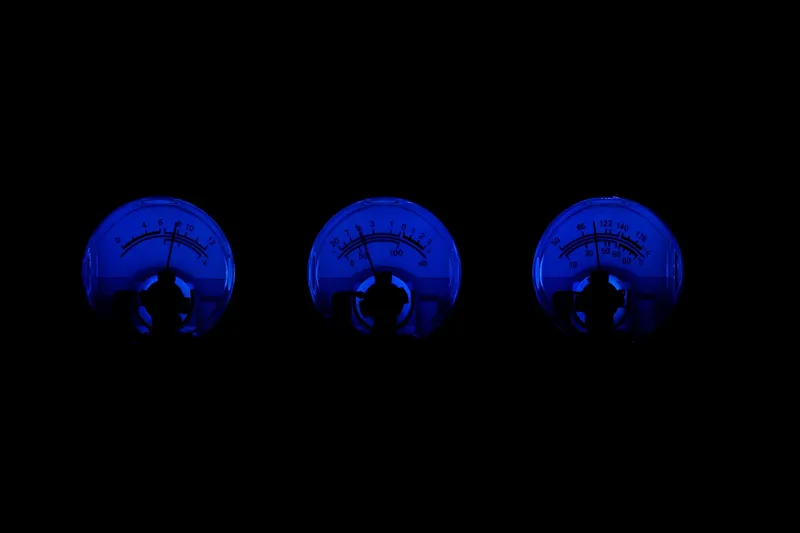
Solar panels output fluctuating voltage depending on sun angle, cloud cover, and temperature. Without a charge controller between the panel and battery, those voltage spikes will overcharge your battery and shorten its lifespan.
That is the entire job of a solar voltage regulator: keep the charging current steady and safe.
The first decision is PWM vs. MPPT. PWM controllers are cheaper and work fine for small systems under 200 watts.
MPPT controllers cost more but extract significantly more energy from larger arrays by adjusting the voltage-to-current ratio in real time. System size should drive that choice, not brand preference.
This list covers 10 solar charge controllers from 8 amps to 60 amps. Each review covers amperage, battery compatibility, waterproofing, and display features.
Quick Comparison Chart
| # | Product | Our Rating | ||
|---|---|---|---|---|
| 1 |  |
Potek 10-Amp Solar Charge Controller | ★★★★★ | Check Price |
| 2 |  |
EEEKit 30A Solar Charge Controller | ★★★★★ | Check Price |
| 3 |  |
EPEVER 30A Flush Mount Solar Charge Controller | ★★★★☆ | Check Price |
| 4 |  |
ZEALLIFE 8A Solar Charge Controller | ★★★★☆ | Check Price |
| 5 |  |
GHB 20A Solar Charge Controller | ★★★★☆ | Check Price |
| 6 |  |
MOHOO 30A Solar Charge Controller | ★★★★☆ | Check Price |
| 7 | 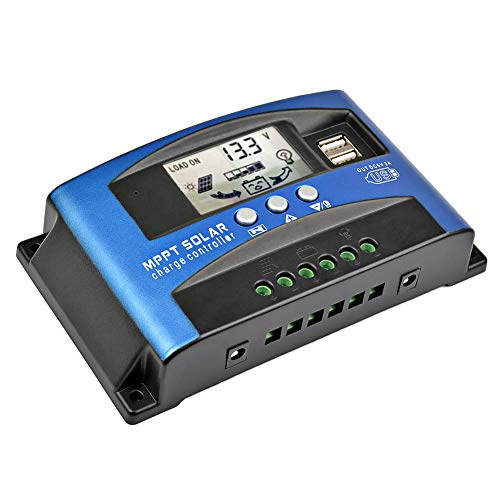 |
AOSHIKE 60A MPPT Solar Charge Controller | ★★★★☆ | Check Price |
| 8 | 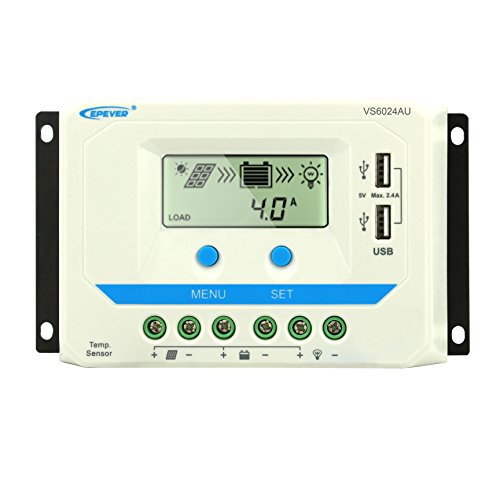 |
EPEVER PWM 60A Solar Charge Controller | ★★★★☆ | Check Price |
| 9 |  |
Bokeley 30A Solar Charge Controller | ★★★★☆ | Check Price |
| 10 |  |
Renogy 30A PWM Wanderer Li | ★★★★☆ | Check Price |
What Separates a Good Solar Voltage Regulator from the Rest
This list covers everything from the compact Potek 10A for a single-panel setup to the AOSHIKE 60A with MPPT tracking at 99% efficiency. We ranked each controller on protection circuitry, charging technology, amperage capacity, and display quality.
PWM controllers cost less and work fine for small 12V systems. If your array is above 400W or you want maximum harvest from every panel, MPPT is worth the price jump.
1. Potek 10-Amp Solar Charge Controller
Potek 10-Amp Solar Charge Controller
Compact 10-amp PWM controller with short-circuit and reverse-connection protection, perfect for small 12V solar setups.
Pros
- Easy setup with great customer support
- Full overcharge and short-circuit protection
- Works independently without a battery
- Ideal for phones, cameras, small systems
Cons
- Limited to 10 amps max current
- No LCD display included
The Potek weighs four ounces and handles up to 10 amps, which is enough for a single small panel powering a phone, camera, or portable lighting setup. Short-circuit and reverse-connection protection are built in, so wiring mistakes will not fry the controller.
The notable feature is battery-free operation. Most charge controllers require a connected battery to function, but the Potek works without one, letting you power devices directly from the panel through the controller.
That makes it useful for daytime-only setups where you do not need energy storage.
There is no LCD screen, so you cannot monitor voltage or amperage in real time. For small systems where you just need basic regulation, that is an acceptable tradeoff given the price and weight.
2. EEEKit 30A Solar Charge Controller
EEEKit 30A Solar Charge Controller
A 30-amp dual USB controller with built-in microprocessor and adjustable LCD display, suitable for home and commercial solar systems.
Pros
- Large adjustable LCD for easy monitoring
- Built-in microcontroller for automatic management
- Reliable multi-protection circuitry
- Works with OPEN, AGM, and GEL batteries
- Simple one-button operation
Cons
- Dual USB maxes at 5V/3A total
- No MPPT tracking technology
The EEEKit steps up to 30 amps with a built-in microprocessor that manages three-stage PWM charging: bulk, absorb, and float. The adjustable LCD display shows battery voltage, charging current, and battery type, giving you real-time monitoring that the Potek lacks.
Dual USB ports output a combined 5V/3A, which is enough to charge a phone while the controller simultaneously charges a 12V battery in an RV or boat. The one-button interface cycles through battery type settings for OPEN, AGM, and GEL chemistries.
It does not support MPPT tracking, so you lose some efficiency compared to MPPT controllers on larger arrays. For systems under 400W, the PWM approach works well enough at this price point.
3. EPEVER 30A Flush Mount Solar Charge Controller
EPEVER 30A Flush Mount Solar Charge Controller
Feature-rich 30-amp controller with real-time energy statistics, app connectivity, and battery temperature compensation for off-grid systems.
Pros
- Real-time energy statistics display
- Control via mobile app or PC software
- Comprehensive protection against 9+ faults
- PWM charging with temperature compensation
- Sleek LCD screen design
Cons
- Requires negative-line grounding only
- Steeper learning curve for beginners
The EPEVER flush mount controller is built for permanent off-grid installations. It displays real-time energy statistics on its LCD, including daily power generation, cumulative energy totals, and current battery state.
You can also monitor and adjust settings remotely through a mobile app or PC software via optional communication peripherals.
Battery temperature compensation adjusts charging voltage based on ambient temperature, which prevents overcharging in hot weather and undercharging in cold weather. This matters for RVs, boats, and cabins where the controller is exposed to wide temperature swings.
The unit protects against nine fault types including overcharge, over-discharge, short circuit, and reverse polarity. It requires negative-line grounding only, which limits compatibility with some positive-ground systems.
The learning curve is steeper than simpler controllers like the Potek, but the data visibility justifies it for anyone managing a larger off-grid system.
4. ZEALLIFE 8A Solar Charge Controller
ZEALLIFE 8A Solar Charge Controller
A compact 8-amp PWM controller with IP68 waterproof rating and SAE plug-and-play connectors for simple 12V battery regulation.
Pros
- IP68 waterproof for outdoor use
- Supports LiFePO4, AGM, GEL, lead-acid
- Zero battery consumption at night
- Simple LED monitoring system
- Tool-free 60-second setup
Cons
- Max 8A and 130W panel input
- No LCD screen included
The ZEALLIFE 8A is the most weatherproof controller on this list with an IP68 rating, meaning it can handle full submersion. That makes it the right pick for marine installs, outdoor-mounted panels, or any location where the controller is directly exposed to rain.
SAE plug-and-play connectors eliminate the need for wire stripping or terminal blocks. You plug the panel into one end and the battery into the other, which brings setup time down to about 60 seconds.
The three clearly separated ports (solar input, battery, load) reduce wiring confusion for first-time users.
Five-in-one protection covers overcharge, over-discharge, overload, short circuit, and reverse polarity. Zero battery consumption at night means the controller does not draw from the battery when the panel is inactive.
The 8A limit caps the panel input at 130W, so this is strictly a small-system controller.
5. GHB 20A Solar Charge Controller
GHB 20A Solar Charge Controller
Fully automatic 20-amp controller with a crisp LCD display, dual USB ports, and intelligent digital charging control.
Pros
- Fully automatic intelligent operation
- Dual USB output for device charging
- Uses 100% of available solar power
- Professional look when wall-mounted
Cons
- No MPPT tracking support
- Limited to 20A rated current
The GHB 20A operates fully automatically once connected. It identifies the battery type, selects the charging parameters, and manages the entire charge cycle without manual input.
A battery indicator light confirms successful connection, which is a simple but helpful feature during initial wiring.
The LCD display shows battery voltage, charging current, and system status clearly enough to read from a few feet away. Dual USB ports provide 5V output for charging phones and small devices.
When wall-mounted, the unit has a clean profile that works well in RV control panels and garage installations.
At 20 amps, this controller supports up to about 260W of panel input on a 12V system or 520W on a 24V system. It does not include MPPT tracking, so it operates as a standard PWM controller.
The output switch allows you to manually disconnect the load without pulling wires, which is useful for seasonal shutdowns.
6. MOHOO 30A Solar Charge Controller
MOHOO 30A Solar Charge Controller
A 30-amp dual USB PWM controller with programmable LCD display and automatic 12V/24V system recognition.
Pros
- Automatic 12V/24V system identification
- Programmable LCD with clear readouts
- Auto shutoff below 8V for safety
- Effective dual reverse current protection
Cons
- LCD unavailable during low-voltage shutoff
- Battery must have sufficient initial voltage
The MOHOO auto-detects whether you have a 12V or 24V system, which means one controller works for either configuration without manual switching. The programmable LCD shows battery voltage, solar input, and load output, and lets you adjust charging parameters through the display interface.
Dual reverse current protection prevents power from flowing backward from the battery to the panel at night, which is a common issue with cheaper controllers that lack this feature. An automatic safety shutoff triggers when battery voltage drops below 8V, which protects deeply discharged batteries from permanent damage.
The LCD screen turns off during this low-voltage state.
PWM charging keeps the battery at optimal levels across sealed, gel, and flooded lead-acid types. The 30A capacity supports up to about 390W of panel input on a 12V system.
7. AOSHIKE 60A MPPT Solar Charge Controller
AOSHIKE 60A MPPT Solar Charge Controller
High-capacity 60-amp controller featuring MPPT tracking technology with up to 99% efficiency and three-phase charge management.
Pros
- MPPT tracking up to 99% efficiency
- Three-phase charge management system
- Built-in overheating and short-circuit protection
- High-power bidirectional MOS anti-backflow
Cons
- Bulkier unit for the high amperage
- LCD interface can be complex
The AOSHIKE is the only MPPT controller on this list, and that matters for larger solar arrays. MPPT technology continuously adjusts the voltage-to-current ratio to extract the maximum possible power from the panels, reaching up to 99% tracking efficiency.
On a 400W+ system, that translates to measurably more daily energy capture compared to any PWM controller here.
Three-phase charge management (bulk, absorption, float) cycles through each stage automatically to extend battery lifespan. Built-in protections cover overheating, overcharging, short circuits, and reverse current flow through high-power bidirectional MOSFETs.
The 60A rating handles large panel arrays on rooftop solar systems and off-grid cabins. The LCD interface shows detailed system data but takes more time to navigate than the simpler single-button controllers.
The unit is physically larger than the PWM options due to the additional MPPT circuitry and heat dissipation requirements.
8. EPEVER PWM 60A Solar Charge Controller
EPEVER PWM 60A Solar Charge Controller
A 60-amp PWM controller with UL/VDE certified terminals, 3-stage intelligent charging, and multiple load control modes.
Pros
- UL and VDE certified terminals
- Supports sealed, gel, and flooded batteries
- Comprehensive PV and battery protections
- Available in 10A, 20A, 30A, 45A options
Cons
- Positive ground design limits some setups
- 12-month warranty is shorter than others
The EPEVER PWM 60A is the highest-amperage PWM controller on this list, supporting large panel arrays on residential and commercial systems. UL and VDE certified terminals ensure the wiring connections meet safety standards, which matters for permanently installed systems that need to pass inspection.
Three-stage intelligent charging handles sealed, gel, and flooded batteries. Multiple load control modes let you configure the controller for different applications, from home solar systems to solar street lights and traffic signals where the load schedule varies.
EPEVER sells this controller in 10A, 20A, 30A, and 45A versions as well, so you can match the amperage to your system size without overpaying for capacity you do not need. The positive-ground design limits compatibility with some setups, particularly systems that use negative-ground inverters.
The 12-month warranty is the shortest on this list, which is worth noting given the higher price point.
9. Bokeley 30A Solar Charge Controller
Bokeley 30A Solar Charge Controller
A straightforward 30-amp PWM controller with 4-stage charge management, dual MOSFET protection, and a clear status display.
Pros
- 4-stage PWM charge management
- One-key setting with auto memory
- Clear status display with mode switching
- Works with AGM, OPEN, and GEL batteries
Cons
- Not compatible with lithium batteries
- Basic feature set compared to others
The Bokeley uses four-stage PWM charge management (bulk, boost, float, and equalization) to maintain battery health over time. The equalization stage periodically overcharges the battery slightly to balance cell voltages, which extends lifespan on lead-acid batteries that sit idle for long periods.
A one-key setting interface with auto memory stores your battery type selection, so the controller remembers your configuration after power cycling. The status display shows charging mode, battery voltage, and fault alerts.
Dual MOSFET reverse-current protection prevents nighttime drain from battery to panel.
It supports AGM, OPEN, and GEL batteries but not lithium chemistries. If you are building a LiFePO4 system, skip this one and look at the Renogy Wanderer Li below instead.
At 30A, it handles up to about 390W of panel input on a 12V system.
10. Renogy 30A PWM Wanderer Li
Renogy 30A PWM Wanderer Li
A compact 30-amp PWM controller with 4-stage charging, IP32 waterproof casing, and support for lithium, AGM, gel, and flooded batteries.
Pros
- Supports LiFePO4, AGM, gel, and flooded
- Compact 5.5 by 3.9 inch footprint
- Tool-free DIN rail or wall mounting
- Optional Bluetooth monitoring via BT-1
Cons
- BT-1 Bluetooth module sold separately
- 12V systems only, no 24V support
The Renogy Wanderer Li is built for users who want lithium battery compatibility in a compact PWM controller. It supports LiFePO4, AGM, gel, and flooded chemistries, automatically selecting the right charging curve through its 4-stage process: bulk, boost, float, and equalization every 25 days.
At just 5.5 by 3.9 by 1.8 inches, it fits into tight RV panels or marine compartments without taking up much space. The IP32 waterproof casing holds up in outdoor installations, and you can add the optional BT-1 Bluetooth module to monitor solar input, battery state of charge, and fault alerts through the Renogy DC Home app.
Final Thoughts
PWM vs. MPPT is the fundamental choice here, and system size determines which one makes sense. The AOSHIKE 60A with MPPT tracking pulls up to 99% efficiency from your panels, which adds up fast on larger arrays.
For small setups under 200W, a PWM controller like the Potek or ZEALLIFE does the job at a fraction of the cost.
The EPEVER 30A flush mount controller impressed us with its app connectivity and real-time energy stats. Being able to monitor charging data from your phone is a genuine convenience, especially on off-grid setups where the controller might be mounted somewhere you cannot easily see.
Waterproofing ratings vary significantly across these controllers. The ZEALLIFE’s IP68 rating handles full submersion, while most other units in this list need protected indoor mounting.
If your controller will be exposed to the elements, that IP rating is not a spec you should overlook.
For anyone building out a complete solar system, choosing the right controller is only half the equation. Pairing it with a quality solar storage battery is how you actually capture and keep the energy your panels produce throughout the day.