 SolarPowerNerd


The fundamental choice in charge controllers is MPPT versus PWM. PWM controllers work by directly connecting the panel to the battery and pulsing the connection to regulate voltage.
They are simple, cheap, and fine for small systems where panel voltage closely matches battery voltage. MPPT controllers convert excess panel voltage into additional amperage, harvesting 20 to 30% more energy from the same panels, especially in partial shade or cold weather when panel voltage rises.
Amp rating determines how many watts of panels your controller can handle. Divide your total panel wattage by your battery voltage to get the minimum amp rating you need, then add 25% headroom.
A 10A controller on a 12V system maxes out at about 130W of panels. Battery compatibility is the other deal-breaker: many budget controllers only work with lead-acid, so if you plan to run lithium, confirm support before you buy.
These 10 controllers span from entry-level 10A PWM units to a waterproof MPPT with SAE plug-and-play, covering setups from a single panel trickle charger to a multi-panel off-grid array.
Quick Comparison Chart
| # | Product | Our Rating | ||
|---|---|---|---|---|
| 1 | 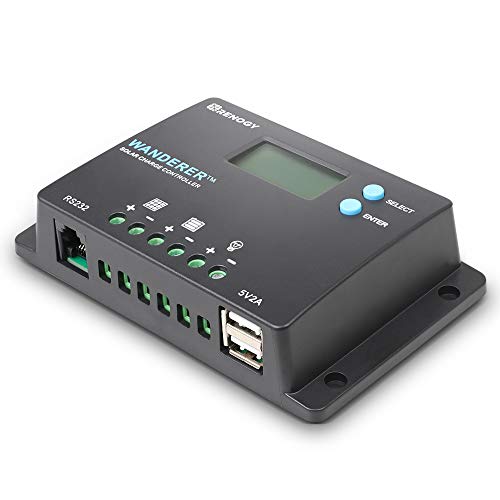 |
Renogy Wanderer 10A PWM Charge Controller | ★★★★★ | Check Price |
| 2 |  |
Victron SmartSolar MPPT 75/15 Controller | ★★★★★ | Check Price |
| 3 |  |
Renogy Rover 40A MPPT Charge Controller | ★★★★★ | Check Price |
| 4 | 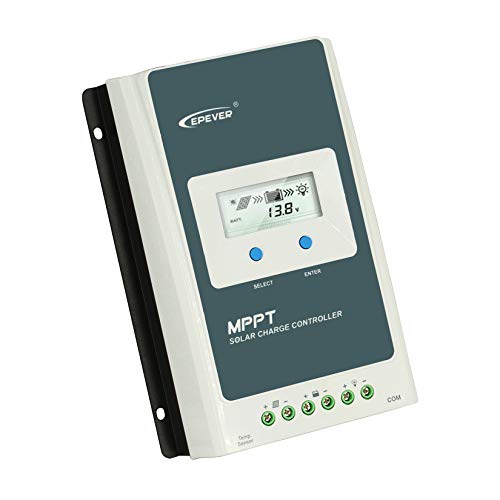 |
EPever 30A MPPT Solar Charge Controller | ★★★★☆ | Check Price |
| 5 |  |
Renogy Adventurer 30A PWM Controller | ★★★★☆ | Check Price |
| 6 |  |
ALLPOWERS 20A Solar Charge Controller | ★★★★☆ | Check Price |
| 7 | 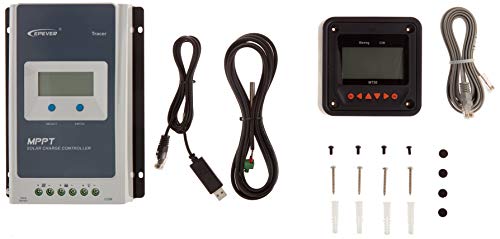 |
EPEVER MPPT Solar Charge Controller 30A | ★★★★☆ | Check Price |
| 8 | 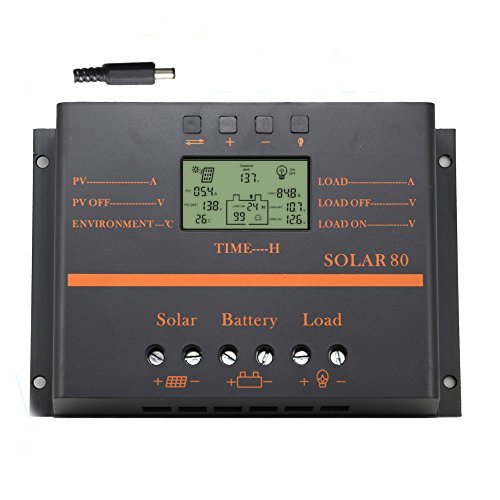 |
Y-Solar 80A PWM Charge Controller | ★★★★☆ | Check Price |
| 9 |  |
GHB 20A Solar Charge Controller | ★★★★☆ | Check Price |
| 10 |  |
SOLPERK MPPT Solar Charge Controller 10A | ★★★★☆ | Check Price |
What Separates a Great Charge Controller From a Mediocre One
The biggest split in this roundup is PWM versus MPPT. The Renogy Wanderer is a solid 10A PWM unit for small setups, but the Victron SmartSolar MPPT 75/15 pulls noticeably more power from partial shade thanks to 99% tracking efficiency.
Battery compatibility is the other thing to check carefully. Some controllers handle lithium, AGM, gel, and flooded batteries, while cheaper models only support one or two chemistries.
1. Renogy Wanderer 10A PWM Charge Controller
Renogy Wanderer 10A PWM Charge Controller
Compact 10A PWM controller with 4-stage charging, LCD display, and broad battery compatibility for 12V/24V systems.
Pros
- Ultra-low self-consumption under 10mA
- Supports AGM, gel, flooded, and lithium
- RS232 port for Bluetooth monitoring
- Negative ground design for safety
Cons
- Only 10A capacity limits panel size
- BT-1 Bluetooth module sold separately
The Renogy Wanderer is a solid starting point for anyone building a small off-grid solar setup. It integrates a PWM charging system with four stages (Bulk, Boost, Float, and Equalization) that work together to extend battery life and prevent overcharging.
Electronic protection guards against installation mistakes, short circuits, and reverse polarity. The controller handles 12V and 24V systems automatically and works with sealed, gel, flooded, and lithium batteries.
A remote temperature sensor monitors battery conditions and adjusts charging through temperature compensation. The RS232 port pairs with the BT-1 Bluetooth module, letting you track voltage, current, and system status from the Renogy smartphone app.
Multiple LED indicators on the front keep you informed of charge status at a glance.
The compact size (5.2 x 3.1 inches) and ultra-low self-consumption make this a great fit for small RV setups, marine panels, and beginner solar projects where simplicity matters most.
2. Victron SmartSolar MPPT 75/15 Controller
Victron SmartSolar MPPT 75/15 Controller
Premium MPPT controller with built-in Bluetooth, intelligent load output, and synchronized multi-unit charging for 12V/24V systems.
Pros
- Maximizes output even in partial shade
- VictronConnect app with 30-day history
- Sync multiple controllers as one system
- Intelligent load disconnect protects battery
Cons
- 15A max limits system size
- Premium positioning vs competitors
The Victron SmartSolar stands out for users who want to connect an entire array of panels into a single monitoring system. Built-in Bluetooth connects directly to the VictronConnect app, giving you real-time voltage, current, and battery state data without any extra modules.
The controller operates in three charging states: Float, Bulk, and Absorption. Float keeps fully charged batteries topped up.
Bulk mode delivers heavy charging after the battery drains from use. The app also stores a 30-day history showing charge cycles and panel performance over time.
Multiple SmartSolar units can synchronize to act as one controller, switching through charge stages together for consistent battery management. The intelligent load output will automatically disconnect devices if battery voltage drops too low, preventing deep discharge damage.
Victron includes a built-in algorithm optimized for lithium batteries. The controller works at 99% tracking efficiency and can handle up to 75V input.
For off-grid setups where monitoring and system flexibility matter, this is one of the strongest options available.
3. Renogy Rover 40A MPPT Charge Controller
Renogy Rover 40A MPPT Charge Controller
High-capacity 40A MPPT controller with dual-peak tracking, 365-day data logging, and dead lithium battery recovery.
Pros
- 99.9% multi-peak tracking efficiency
- Handles 6kV lightning surge protection
- Revives over-discharged lithium batteries
- Backlit LCD with real-time error codes
Cons
- Larger physical footprint than PWM units
- BT module for app monitoring sold separately
The Renogy Rover comes in 20A, 30A, and 40A versions, making it scalable across different system sizes. The 40A model can support up to 800W on a 24V system, which gives serious off-grid users room to grow.
An aluminum shell dissipates heat effectively while protecting against wear. The controller is self-diagnostic and displays error codes on the backlit LCD for quick troubleshooting.
It handles gel, sealed, flooded, and lithium battery types, and you can switch between them from the front screen menu.
A USB communication cable enables remote sensing through optional PC software, letting you customize charge parameters and settings. The Rover is also compatible with the BT-1 Bluetooth module for smartphone monitoring via the RS232 port.
With 99.9% dual-peak tracking efficiency and the ability to revive over-discharged lithium batteries, the Rover is built for users running larger panel arrays who need precise control and detailed data logging.
4. EPever 30A MPPT Solar Charge Controller
EPever 30A MPPT Solar Charge Controller
Solid 30A MPPT controller with 100V max input, auto 12V/24V detection, and broad battery support including lithium.
Pros
- Handles up to 100V solar input
- Works with gel, sealed, flooded, lithium
- LCD display shows charging status
- Common negative ground design
Cons
- MPPT needs 10W minimum to activate
- Limited documentation included
The EPever MPPT controller handles 30A and accepts up to 100V max PV input, which gives you flexibility to wire panels in series for higher voltage strings. It uses automatic voltage identification for 12V/24V systems and remembers previous settings through auto-saving.
Four-stage battery charging and an LCD screen keep you informed about charge levels and system health. The controller supports sealed, flooded, gel, and lithium battery types, switching between work modes as needed.
Temperature compensation adjusts charging parameters based on ambient conditions, which helps protect batteries in extreme heat or cold. The negative ground design follows the same wiring standard as most RV and marine systems.
One thing to note: the MPPT function requires at least 10W of incoming power to activate. Below that threshold, it behaves more like a basic controller.
For medium-sized systems running 12V to 24V battery banks, the EPever delivers solid MPPT performance without overcomplicating the setup.
5. Renogy Adventurer 30A PWM Controller
Renogy Adventurer 30A PWM Controller
Flush-mount 30A PWM controller designed for RVs and campers, with Bluetooth monitoring and wide battery compatibility.
Pros
- Sleek flush mount fits RV walls
- Works down to negative 4F temperatures
- Charges lithium, AGM, gel, and flooded
- Front USB port for device charging
Cons
- PWM less efficient than MPPT models
- Surface mount kit needed for non-flush install
The Renogy Adventurer stands out with its flush-mount design, built specifically for RV and camper walls. It sits flat against the surface for a clean, integrated look.
A surface mounting attachment is also included for setups where flush mounting is not an option.
The front panel includes a USB port for charging phones and tablets, along with an LED display showing voltage and battery temperature. The BT-1 Bluetooth module connects to the Renogy smartphone app for remote monitoring on screen.
Like other Renogy controllers, the Adventurer uses 4-stage PWM charging (Bulk, Boost, Float, and Equalization) across 12V and 24V systems. It supports sealed, gel, flooded, and lithium batteries, and the self-diagnostic system catches installation errors before they cause damage.
The controller operates in temperatures from negative 4F to 140F with automatic temperature compensation. For RV and camper owners who want a controller that blends into the interior while still delivering reliable charging performance, the Adventurer is purpose-built for the job.
6. ALLPOWERS 20A Solar Charge Controller
ALLPOWERS 20A Solar Charge Controller
Simple 20A PWM controller with USB port and automatic voltage regulation for small 12V/24V solar setups.
Pros
- Simple setup for beginners
- Built-in short and open circuit protection
- USB output for charging small devices
- Lightweight and compact design
Cons
- No lithium battery support
- Lead acid batteries only (AGM, GEL, open)
The ALLPOWERS controller is a compact, no-frills option for small solar systems. It runs at 20A with 12V/24V automatic detection, and it includes built-in circuit protection against short circuits and open circuits.
The controller regulates solar panel output automatically. Once battery voltage drops below 8V, the system shuts down to prevent deep discharge damage.
A USB output at 5V/3A gives you a convenient port for charging phones or small devices.
Keep in mind that this controller is designed for lead acid batteries only, including AGM and GEL types. It does not support lithium ion or other chemistries.
The operating temperature range runs from negative 35C to 60C, so it should be kept in a shaded, well-ventilated location away from direct sun exposure.
For beginners building their first small panel setup, the ALLPOWERS delivers straightforward performance with easy installation and basic protection features.
7. EPEVER MPPT Solar Charge Controller 30A
EPEVER MPPT Solar Charge Controller 30A
30A MPPT controller with 99.5% tracking efficiency, 100V max PV input, and built-in lithium battery presets for 12V/24V systems.
Pros
- Advanced MPPT algorithm maximizes solar harvest
- Built-in presets for LiFePO4 lithium batteries
- Handles up to 100V solar panel input
- Works with both 12V and 24V systems
- Includes MT50 remote meter and sensors
Cons
- Heavier than comparable PWM controllers
- Remote meter adds wiring complexity
The EPEVER 3210AN is a 30A MPPT controller built around a negative grounding design and an advanced tracking algorithm that reaches 99.5% charging efficiency. It accepts up to 100V PV input, which lets you wire four 12V panels in series to reduce current loss across longer cable runs.
One of the standout features is built-in support for LiFePO4 and Li(NiCoMn)O2 lithium batteries with preset charging parameters. You do not need to manually configure voltage setpoints for lithium, which removes a common source of setup errors.
The included MT50 remote meter gives you a separate display for monitoring voltage, current, and battery state from a convenient location. A temperature sensor and PC communication adapter also come in the box, so you get a complete monitoring package without buying extras.
For off-grid builders who want reliable MPPT performance with lithium compatibility and full remote monitoring out of the box, the EPEVER 30A handles the job without overcomplicating installation.
8. Y-Solar 80A PWM Charge Controller
Y-Solar 80A PWM Charge Controller
High-amperage 80A PWM controller with simplified LCD, aluminum housing, and low voltage disconnect for 12V/24V systems.
Pros
- 80A rating handles large panel arrays
- Corrosion-resistant aluminum build
- Easy LCD readable by beginners
- Auto low voltage disconnect protects battery
Cons
- PWM only, no MPPT tracking
- Basic feature set for the capacity
The Y-Solar 80A stands out for its high current rating, one of the highest on this list. It works with 12V/24V batteries and uses a simplified LCD that even first-time solar users can read without a manual.
The controller is built with heat-dissipating, corrosion-resistant aluminum and comes with a 2-year manufacturer warranty. It includes connection ports for the solar panel, battery bank, and load, along with a remote monitoring port for tracking system performance.
Low Voltage Disconnection (LVD) automatically shuts the system down when battery voltage drops too low, preventing deep discharge damage. The self-cooling fins on the back keep the unit running without an active fan.
The Y-Solar also uses both PWM and MPPT charging modes, which gives it an edge in regulation flexibility. LED indicators and simple operational buttons make daily use straightforward.
For users who need high amperage capacity in a controller that keeps things simple, the Y-Solar fills that role.
9. GHB 20A Solar Charge Controller
GHB 20A Solar Charge Controller
Entry-level 20A PWM controller with clear LCD, full automatic operation, and comprehensive protection features for basic solar setups.
Pros
- Plug and play automatic operation
- Easy to install and mount
- Lightning and reverse polarity protection
- USB output for small device charging
Cons
- Temperature display in Celsius only
- 20A limits scalability for larger systems
The GHB 20A is a fully automatic controller that keeps things simple. Connect the battery, and the indicator light confirms the link.
The LCD screen with an energy-saving backlight displays all key parameters clearly.
The protection feature set is solid for a basic unit: lightning protection, overcharging protection, under-voltage protection, overload and short circuit protection, and reverse polarity protection. The PWM and WPC modes work together to improve system efficiency and extend battery lifespan.
The controller runs at 20A rated discharge current with a 5V USB output for charging small devices. DC output voltage covers both 12V and 24V systems.
Installation is straightforward, with easy wire connections and simple mounting.
The one limitation is that the temperature indicator only reads in Celsius. For users who want a dependable entry-level controller that handles the basics without any complicated setup, the GHB delivers solid protection and automatic operation.
10. SOLPERK MPPT Solar Charge Controller 10A
SOLPERK MPPT Solar Charge Controller 10A
Compact IP67 waterproof MPPT controller with SAE plug-and-play connectivity and LED status indicators for 12V systems.
Pros
- 30% more efficient than PWM controllers
- Supports AGM, gel, flooded, and LiFePO4
- SAE port for fast plug-and-play setup
- Color-coded LED status indicators
Cons
- 12V systems only, no 24V support
- 10A limits total panel wattage
The SOLPERK MPPT controller is built for situations where the controller itself sits exposed to the elements. With an IP67 waterproof rating, it can handle rain, dust, and harsh outdoor conditions that would damage most standard charge controllers.
The compact housing keeps it unobtrusive on a boat deck, tractor battery, or gate opener panel.
Where this unit differentiates itself is the SAE connector. Instead of stripping wires and clamping terminal screws, you plug in with an SAE port and you are up and running.
Three color-coded LEDs (blue for panel connection, red for battery link, green for full charge) give you instant status without needing a display or app.
SOLPERK rates this controller at 30% higher efficiency than comparable PWM units, and it works with most 12V battery types including AGM, lead acid, gel, deep cycle, sealed, flooded, and LiFePO4 lithium. Built-in protection covers under-voltage, over-voltage, overload, short circuit, and reverse connection.
For maintaining a 12V battery on a remote gate, RV in storage, or small trickle-charge setup, the SOLPERK keeps things waterproof and simple.
Final Thoughts
The Renogy Wanderer and Victron SmartSolar sit at opposite ends of the price spectrum, but both deliver reliable charging with real monitoring options. If you are running a larger panel array and want maximum harvest from every watt, the Renogy Rover 40A MPPT with its dead battery recovery feature is hard to beat.
For RV owners who want a clean install, the Renogy Adventurer’s flush-mount design makes it look like it belongs in the wall. The Y-Solar 80A handles big panel arrays on a budget if you can live without MPPT tracking.
Waterproofing is worth considering if your controller will be exposed to the elements, and the SOLPERK’s IP67 rating with SAE plug-and-play makes outdoor installs painless. If you are also shopping for panels to pair with your new controller, our guide to the best solar panels for RVs covers compatible options.
Battery type matters just as much as amperage rating when picking a controller. Several units here only support lead acid, so if you plan to run lithium batteries down the road, double-check that spec before you buy.