 SolarPowerNerd

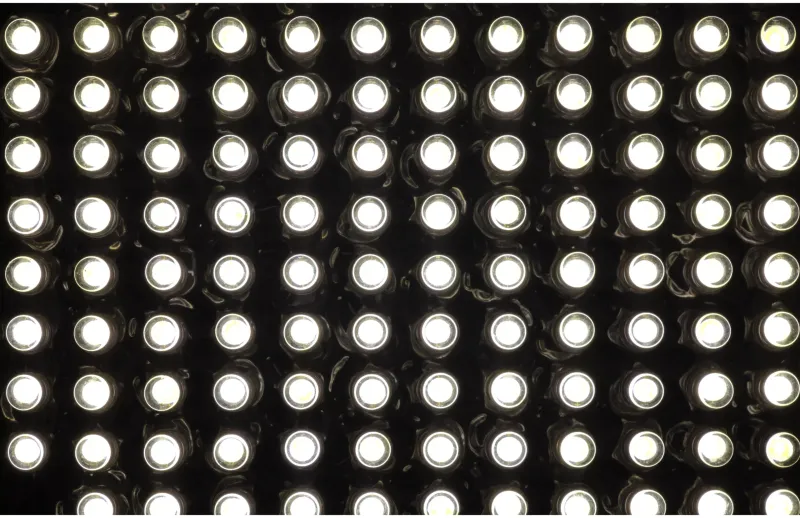
LEDs and solar panels share a common building block: semiconductor materials. That overlap leads many people to wonder whether one can do the other’s job.
Here’s what the science actually says and why it matters for your setup.
Can LEDs Produce Electricity Like Solar Panels?
LEDs can technically generate small amounts of electricity from light. Both LEDs and solar panels rely on semiconductor materials to interact with light energy.
The key difference is that solar panels capture a broad range of light frequencies, while LEDs emit just one specific frequency.
In theory, an LED could act as a tiny solar cell that captures only one narrow frequency. In practice, this is wildly inefficient and only works in controlled lab settings.
For an LED to function like a real solar panel, it would need modifications to capture a much broader light spectrum.
Are Solar Panels Better Than LEDs at Generating Power?
Solar panels are far more efficient than LEDs at converting light into electricity. They’re built to capture a broad range of light frequencies, while LEDs only handle one narrow band.
Solar panels are also much larger, so they capture significantly more light. They can store energy in batteries for use at night or during outages.
LEDs need an external power source to operate.
Solar panels are more durable too, lasting decades with proper care. LEDs have a shorter lifespan and need replacement every few years.
Solar panels are also more eco-friendly since they don’t contain toxic materials.
Can LED Light Charge Solar Watches?
Yes, LED light can charge solar watches. Solar watches rely on light to charge, and they’ll work with any light source, including LEDs.
LED light is bright and efficient, making it a popular choice for charging solar-powered devices indoors. Place the watch in direct sunlight or close to the LED source for the best results.
Charging times vary depending on available light and the watch model. Most solar watches reach a full charge after a few hours of exposure.
How Does Color Temperature Affect Solar Panels?
The sun’s “color temperature” affects solar panels in two ways: through visible light and infrared radiation. Blue light has shorter wavelengths and higher energy than red light.
Infrared radiation is invisible but felt as heat.
When sunlight hits a solar panel, some energy converts into electricity while most becomes heat. That heat causes semiconductor materials to expand, reducing efficiency.
Hot solar panels produce less electricity than cooler ones. If you want your panels to perform at their best, installing them where airflow keeps temperatures down makes a big difference.
Understanding why panels face south also helps maximize output.
How Do You Connect LED Lights to Solar Panels?
You can connect LED lights to solar panels in a few different ways.
Micro-inverters sit on each individual solar panel and convert DC power into AC power. That AC power then runs your LED lights.
A central inverter is placed near the solar panels and handles the same DC-to-AC conversion for the entire array. It’s a simpler setup for larger installations.
A DC-to-DC converter sits between the panels and the LED lights. It adjusts the DC voltage from the panels to a level the LEDs can use directly, skipping the AC conversion entirely.
Do Solar Panels Need Sunlight or Just Light?
Solar panels work with both sunlight and artificial light. Their photovoltaic cells can convert any light source into electricity.
That said, they perform best under direct sunlight. Panels still function on cloudy days, but output drops significantly in low-light conditions.
To maximize your savings, place panels where they’ll get the most direct sunlight possible. Learning how solar energy works step by step can help you optimize your setup.
Can LED Lights Be Used to Power Appliances?
LEDs use less energy than traditional incandescent bulbs. They generate less heat and last much longer.
While LED bulbs cost more up front, they save money over time. The same logic applies when using them to generate power.
LEDs can provide enough energy for very small devices, but they won’t work for larger appliances. You’d need actual solar panels for anything beyond tiny electronics.
Can You Charge Solar Panels With LED Lights?
You can charge solar panels with LED lights, though it’s not efficient. The sun’s rays contain electromagnetic energy that panels convert into direct current (DC) electricity.
LED lights also produce electromagnetic energy as visible light. Solar panels can absorb this light and use it to charge batteries, just at a much lower rate than sunlight provides.
When the batteries are full, excess stored energy can power the LEDs. This creates a loop, but you’ll always lose energy in the process.
Are There Disadvantages to Trickle-Charging Solar Panels With LED Lights?
Trickle-charging solar panels with LED lights can work, but there are a few things to keep in mind.
First, make sure the trickle charger is the right size for your panel. If it’s too small, it won’t provide enough power to keep things running properly.
Second, be careful when connecting the charger to the panel. Incorrect wiring can cause damage.
Third, monitor the charger while it’s in use. If it overheats, it can damage the panel or create a fire risk.
Take these precautions and you should be fine.
How Long Will Solar Panels Last With LED Lighting?
When paired with LED lighting, solar panels can last up to 25 years. LEDs are more efficient than incandescent bulbs and generate less heat.
Because of that, solar panels don’t have to work as hard to produce the same amount of light. This lighter workload extends their overall lifespan.
4 Reasons to Power LED Lights With Solar Panels
Here are four reasons to power LED lights with solar panels instead of grid electricity.
LEDs Are Energy-Efficient and Save on Costs
LED lights use less electricity and last longer than incandescent bulbs. You’ll save money on your energy bill over time.
LEDs Are Safe
Solar panels produce electrical energy without generating heat like fossil fuels. This makes them a safe, cool-running option for powering LED lights.
Solar Panels Are Environmentally Friendly
Solar panels run on sunlight, a renewable resource. They’re far better for the environment than fossil-fuel-based electricity generation.
Solar Panels and LEDs Have Long Life Spans
Solar panels last up to 25 years, and LED lights have a lifespan of around 50,000 hours. You won’t need to replace them often, saving money in the long run.
Frequently Asked Questions
Can an LED power a solar panel efficiently?
No. LEDs produce only a narrow band of light, so they generate very little electricity when used as a solar cell. The energy output is a tiny fraction of what a real solar panel delivers from sunlight.
It’s a fun science experiment, but it’s not practical for powering anything useful in your home.
Do solar panels work with indoor LED lighting?
Yes, solar panels can absorb indoor LED light and produce small amounts of electricity. The output is much lower compared to direct sunlight.
Indoor charging works for small devices like solar watches or calculators, but it won’t generate enough power for home appliances or larger electronics.
How many LED lights can one solar panel run?
A standard 300-watt solar panel can power roughly 30 LED bulbs rated at 10 watts each. The actual number depends on your panel’s wattage, the LED bulb ratings, and how many hours of sunlight your area receives daily.
Battery storage lets you run them after dark.
Is it worth pairing solar panels with LED lights?
Absolutely. LED lights consume far less energy than traditional bulbs, meaning your solar panels can stretch further.
The combination lowers electricity costs, reduces grid dependence, and extends the lifespan of your entire system. It’s one of the simplest solar upgrades you can make.
Final Thoughts
You can absolutely power LED lights with solar panels. The combination makes sense because LEDs draw so little power that even a modest panel setup handles them easily.
Just match your charger size to your panel, wire connections carefully, and monitor for overheating. With those basics covered, you’ll get years of reliable, low-cost lighting.