 SolarPowerNerd

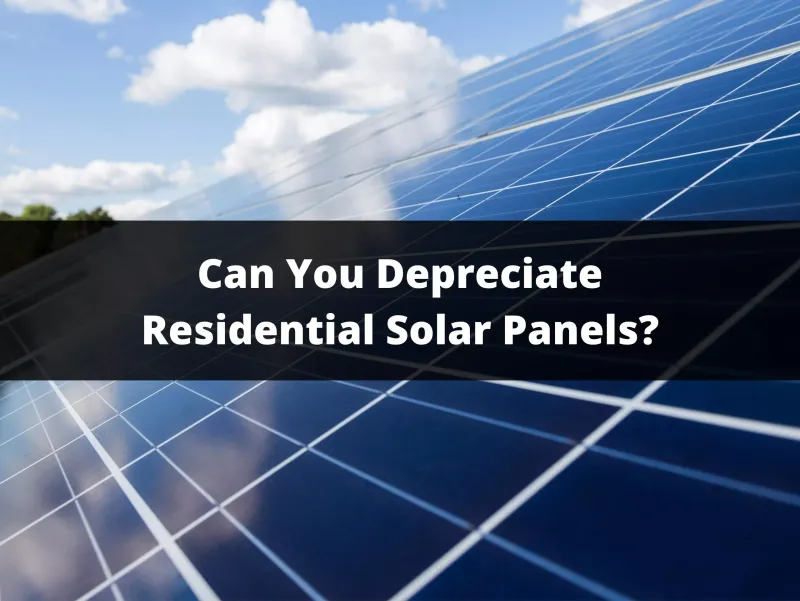
Solar panels aren’t just an energy investment. They’re also a tax asset.
If you’ve been wondering whether you can write off your home solar system, the short answer is yes, and the savings can be substantial.
How Solar Panel Depreciation Works
You can depreciate residential solar panels on your taxes. Start by finding the total cost of your system, either from the purchase price or the manufacturer.
Next, determine the useful life. The IRS lists the useful life of solar panels as 20 years.
Once you have both numbers, you can calculate depreciation using a standard formula.
This deduction can be a valuable tax benefit for homeowners who install panels on their property.
Modified Accelerated Cost-Recovery System (MACRS) for Solar Projects
The MACRS is a method of depreciation that allows businesses to write off the cost of solar projects over a set period of time. The MACRS has two parts: the Standard Depreciation System (SDS) and the Alternative Depreciation System (ADS).
The SDS is the most commonly used method, and it allows businesses to write off the cost of solar projects over a five-year period. The ADS is less commonly used, but it allows businesses to write off the cost of solar projects over a seven-year period.
Which method you use depends on your company’s tax situation. Talk to your accountant to see which one fits best.
Either way, MACRS is an important tool for businesses looking to invest in solar projects.
Example of Calculating Accelerated Depreciation Solar Energy
You can calculate accelerated depreciation for solar energy by subtracting the expected salvage value from the total cost of the equipment.
The resulting number is then divided by the useful life of the equipment in years. The result is the yearly depreciation expense that can be used for tax purposes.
For example, let’s say you purchase a solar energy system for $10,000. The system has an expected salvage value of $1,000 and a useful life of 10 years.
To calculate the accelerated depreciation expense, you would subtract $1,000 from $10,000 to get $9,000. You would then divide $9,000 by 10 to get $900.
This means that you can deduct $900 per year for solar energy depreciation on your taxes.
Here’s another example. Say you purchase a solar energy system for $20,000 with an expected salvage value of $2,000 and a useful life of 10 years.
Subtract $2,000 from $20,000 to get $18,000, then divide by 10.
That gives you $1,800 per year in solar energy depreciation on your taxes.
Key Takeaway
You can depreciate residential solar panels to save on your taxes. The process is straightforward and gives you a valuable deduction if you have solar installed on your property.
Talk to your accountant to see if this approach works for you.
Tax Benefits and Credits
Two main tax benefits apply to solar panels: the federal investment tax credit (ITC) and the solar renewable energy credit (SREC).
The ITC lets you deduct 30% of installation costs from your federal taxes. The SREC lets you deduct 10% of the cost of producing electricity from your panels.
Many states offer extra incentives too. California, for example, has a property tax exemption for solar panels on your primary residence.
Check out our guide on why solar power is good for the environment for more on the broader benefits.
Tax Cuts and Jobs Act (TCJA)
The Tax Cuts and Jobs Act (TCJA) was passed by Congress in December 2017 and became law on January 1, 2018. The TCJA generally lowered income tax rates and modified certain deductions, exemptions, and credits.
The biggest changes involved individual income tax rates and the standard deduction. The law reduced tax brackets from seven to five and lowered marginal rates for most individuals.
The standard deduction nearly doubled, while personal exemptions were eliminated. These TCJA changes were scheduled to expire after 2025 unless Congress voted to extend them.
So what does this mean for solar panels?
The good news is that the federal investment tax credit for solar panels was not affected by the TCJA. This means that you can still deduct 30% of the cost of installing a solar panel from your federal taxes.
The bad news is that the new law may make it more difficult to take advantage of the solar renewable energy credit. This is because the new law increased the standard deduction and eliminated personal exemptions.
This means that fewer people will itemize their deductions on their federal tax return, which is required in order to claim the solar renewable energy credit.
Key Takeaway on TCJA
The Tax Cuts and Jobs Act didn’t eliminate the federal investment tax credit for solar panels. The law may, however, make it harder to take advantage of the solar renewable energy credit.
Cost Vs. Benefits of a Solar System
Solar panels can be pricey up front. But the long-term benefits, both financial and environmental, often outweigh the initial cost.
Solar energy is renewable, so it won’t run out like fossil fuels. It’s also much cleaner than coal or natural gas, meaning less pollution and a smaller carbon footprint.
Prices keep dropping as technology improves. In many cases, solar power can save you real money on your electric bill.
Paired with tax incentives, the payback period is shorter than most people expect.
Advantages of Depreciation for Businesses
Depreciation is an important tool for businesses, but what exactly is it?
The IRS allows businesses to write off the cost of certain assets over time. That means you can deduct a portion of the cost of equipment, vehicles, and buildings from your taxes each year.
This reduces your annual tax bill and frees up cash to reinvest. Depreciation can also make financing easier because lenders often view fully depreciated assets as lower risk.
Businesses that use depreciation effectively save on taxes and gain access to more affordable financing.
What are Federal and State Savings?
The federal solar tax credit will let you deduct up to 30 percent of the cost of installing a solar energy system from your federal taxes. The ITC applies to both residential and commercial systems, and there is no limit on its size.
In order to take advantage of the credit, you must have filed your taxes for the year in which you installed the system. The credit is set to decrease over time, so it’s important to act now if you’re thinking about going solar.
In contrast to the federal government, each state has its own policies when it comes to solar power. Many states offer solar incentives in the form of tax credits or rebates.
Some states also have requirements that utilities source a certain amount of their power from renewable energy, which has helped to drive down the cost of solar panels.
Solar panels can help you save money on your electric bill, and there are also a number of financial incentives available to help offset the cost of installation.
Federal and state governments offer tax credits, rebates, and other programs that make going solar more affordable. Research what incentives are available in your area before making the switch.
Understanding how many panels you need to power a house can also help you estimate total costs.
Benefits of Going Solar for Companies
Here are some benefits of going solar for companies.
Solar Renewable Energy Certificate (SREC)
The SREC is a certificate that is given to solar energy system owners for each megawatt-hour (MWh) of solar power that they generate. The value of the SREC depends on the market price of renewable energy, but it can be worth hundreds or even thousands of dollars.
Solar Renewable Energy Credits (SRECs) are a valuable commodity that can be sold to utilities in order to help them meet their renewable energy goals.
The money from the sale of SRECs can be used to offset the cost of the solar energy system, making it more affordable for businesses.
Net Metering
Net metering is a billing system that allows businesses with solar panels to sell excess electricity back to the grid.
This can help businesses offset the cost of their electric bill, and it can also provide a source of revenue.
In order to use net metering, businesses need to have a solar energy system that is connected to the grid.
Net metering policies vary from state to state, so it’s important to research the regulations in your area.
Solar Power Purchase Agreement (PPA)
A solar PPA is an agreement between a business and a solar developer in which the developer agrees to install, maintain, and operate a solar energy system on the business’s property.
The business then agrees to purchase the electricity generated by the system at a fixed rate for a specified period of time.
Solar PPAs can help businesses save money on their electric bills, and they can also provide a hedge against future utility rate hikes.
Solar leases are similar to solar PPAs, but they typically have a shorter term and the payments are made monthly instead of upfront.
Solar leases can be a good option for businesses that want to go solar with little or no money down.
Rebate From My State Government
State governments offer a variety of incentives to businesses that go solar.
For example, in the state of Washington, businesses can receive a rebate of up to $5,000 for installing a solar energy system.
In the state of California, businesses can receive a rebate of up to $1.80 per watt of solar power installed.
Be sure to research the incentives that are available in your state before going solar.
Solar Tax Incentives for Businesses
The federal government gives businesses a tax credit for installing solar energy systems. The credit equals 30% of the system cost, and you can use it to offset federal income taxes.
The solar tax credit is available for both residential and commercial solar energy systems.
To get the solar tax credit, businesses must have a tax liability. The credit can be carried forward for up to five years if it is not used in the year it is earned.
Solar Energy Grants for Businesses
The U.S. Department of Energy has grants and loans available for businesses that install solar energy systems.
The grants are awarded on a competitive basis, and the amount of the grant depends on the project.
In order to be eligible for a grant, businesses must have a tax liability.
Solar Energy Loans for Businesses
The U.S. Department of Energy offers loans to businesses that install solar energy systems.
The loans are available on a first-come, first-served basis, and the interest rate is 4% for a term of up to 30 years.
In order to be eligible for a loan, businesses must have a tax liability.
Benefits of Solar For Residential Solar Depreciation
Now let’s take a look at some benefits of solar depreciation for residential properties.
Solar Energy Systems Increase the Value of Your Property
Solar energy systems can increase your property value by as much as 20%. They add value without increasing the property’s footprint.
Solar systems can also provide a source of income through net metering and energy credits.
Solar Energy Systems Can Save You Money on Your Electric Bill
Solar energy systems can save you money on your electric bill by offsetting the cost of your electricity.
The average solar energy system can save a homeowner $600 per year on their electric bill.
Solar Energy Systems Can Help You Save on Your Taxes
Solar energy systems can help you save on your taxes by providing you with a tax deduction.
The federal government gives homeowners a tax credit for installing solar energy systems.
The tax credit is equal to 30% of the cost of the system.
Solar energy systems can also help you save on your state taxes.
Low Energy Bills
Solar energy systems can help you save money on your electric bill.
The average solar energy system can save a homeowner $600 per year on their electric bill.
In addition, solar energy systems can provide a source of income for property owners.
Solar Energy Systems Require Little Maintenance
Solar energy systems need very little maintenance once installed. Panels have no moving parts, so there’s nothing to service regularly.
They’re durable and can last for decades with minimal upkeep.
Can You Take Section 179 on Solar Panels?
In the IRS tax code, Section 179 lets businesses deduct the full purchase price of qualifying equipment and software that is installed during the tax year.
This deduction is available for both new and used equipment, and it can be a valuable way to reduce your tax liability. Solar panels are considered qualifying equipment for the Section 179 deduction, which means that you can deduct the full purchase price of your solar panel system from your business taxes.
To file for this deduction, you must purchase and install your solar panel system before the end of the tax year. This deduction can be a valuable way to save money on your business taxes, so be sure to talk to your accountant or tax advisor before making any final decisions.
Frequently Asked Questions
Can homeowners use MACRS depreciation on solar panels?
MACRS depreciation is primarily designed for business and commercial solar installations. Residential homeowners typically benefit more from the federal Investment Tax Credit, which covers 30% of installation costs.
If you use part of your home for business, you may qualify for MACRS on that portion of the system.
How long does it take to recoup a solar panel investment?
Most homeowners recoup their solar investment within 7 to 12 years through electricity savings and tax credits combined. The exact timeline depends on your local electricity rates, available sunlight hours, system size, and which state and federal incentives you claim during the payback period.
Does the federal solar tax credit expire?
The federal Investment Tax Credit for solar has been extended multiple times. Current legislation keeps the 30% credit available through 2032, after which it steps down gradually.
Checking the latest IRS guidelines or consulting a tax professional helps you catch every credit you qualify for.
Can I depreciate solar batteries along with panels?
Yes, solar battery storage systems qualify for the same federal tax credits and depreciation schedules as solar panels themselves. The battery must be charged by the solar system at least 75% of the time to qualify.
This makes adding a solar storage battery even more financially attractive.
Final Thoughts
Yes, you can depreciate residential solar panels. The type of system, your location, and your tax situation all affect how much you’ll save.
Talk to your tax advisor about combining depreciation with available credits. The potential savings make solar one of the smartest long-term investments for homeowners and businesses alike.